


|
Getting your Trinity Audio player ready...
|
Update: After this article was published, legislative leaders released an updated version of the crime bill, which they’re calling “Iryna’s Law.” Among the changes from the draft bill that The Assembly obtained on Friday: Defendants undergoing potential mental health crises will no longer be jailed for up to 72 hours before being evaluated, and police officers will be required to inform judicial officials if someone they arrest might be a “danger to themselves or others.” In addition, the new version allows courts to extend probation terms for up to three years for juveniles who commit serious crimes and requires juveniles who have committed serious crimes to complete three years of post-release supervision. It also gives the Mecklenburg DA’s office 10 additional prosecutors. The Assembly will continue to report on this developing story.
***
On September 11, six days after Charlotte authorities released the gruesome video of 23-year-old Iryna Zarutska’s killing on the city’s light rail three weeks earlier, Republican legislative leaders called a press conference to announce a crackdown that House Speaker Destin Hall said would “prevent those things in the future.”
But before getting into the details, Hall and Senate leader Phil Berger passed the mic to Michael Whatley, who isn’t an elected official and would play no role in crafting lawmakers’ response.
Whatley, a former Republican National Committee chairman and ally of President Donald Trump, is running for U.S. Senate and will likely face former Democratic Gov. Roy Cooper. Trailing in early polls, Whatley saw an opening.
“Roy Cooper has a history of being soft on crime,” Whatley declared, after blaming Democrats’ rhetoric for the assassination of conservative activist Charlie Kirk the day before. “He let 3,500 criminals free, and the killer who killed young Iryna, he was released just three months after one of Cooper’s soft-on-crime executive orders in 2020 and 13 additional times after he was arrested.”
Whatley echoed Trump, who days earlier had posted on social media that the “blood of this innocent woman” is “on the hands of the Democrats who refuse to put bad people in jail, including Former Disgraced Governor and ‘Wannabe Senator’ Roy Cooper.”

This claim collapses under scrutiny.
Cooper released 3,500 nonviolent offenders in 2021 to settle a lawsuit over COVID-19 conditions in state prisons. But the settlement had nothing to do with the release of Decarlos Brown Jr., Zarutska’s alleged murderer, from the Avery-Mitchell Correctional Institution in September 2020. Nor was Brown freed because of the executive order that Whatley cited, which established a task force to study racial disparities in the justice issues in the wake of George Floyd’s murder.
Brown, who is now 34 and said to have schizophrenia, was released because he completed his 73-month sentence for armed robbery, according to the Department of Adult Correction. He wasn’t paroled or released early. He was sentenced under legal guidelines that have been in place for decades.
This week, the General Assembly plans to pass legislation that Republicans believe will send a tough-on-crime message. The Assembly obtained a draft of the bill on Friday afternoon. A final version is expected to be released on Monday.
Among other things, the draft bill restricts cashless bail and attempts to speed up executions. It also allows judges and magistrates to hold any defendant in jail without a hearing for up to three days for a mental health evaluation, raising due process questions.
Critics say most of these proposals will do little to prevent future tragedies like Zarutska’s killing. Tackling reforms that might—in particular, ensuring that the mentally ill get treatment—will be expensive and complicated.
The General Assembly vastly increased mental health care spending as part of Medicaid expansion in 2023. But the system is still plagued by shortages of providers and space in psychiatric hospitals.
Perhaps as a nod to that reality, the bill commissions a report from the North Carolina Collaboratory on “the intersection of mental health and the justice system.” But it won’t be finished until 2027.
Right now, Republican lawmakers appear more concerned with demonstrating a muscular response to a horrific crime.
“This is a moment where the emotions of the case are heightened, and it’s just critical that we assess what happened and make level-headed policy recommendations to prevent this in the future,” said Tarrah Callahan, of the Raleigh-based group Conservatives for Criminal Justice Reform. “Any policy decisions must be balanced so that we do not unintentionally undermine the very systems and people we rely on to keep us safe.”
‘Stranger Homicides’
The young woman steps into the Blue Line car in Charlotte’s South End neighborhood at 9:46 p.m. on August 22. Her long, blonde hair is tucked into a black baseball cap. AirPods block out the Friday night noise. She looks tired. She just got off work at a pizzeria and is headed home to the NoDa apartment she rents with her boyfriend.
She sits one row in front of a man who had boarded without paying sometime earlier. He is Black, 5 feet 10 inches tall, and wears an orange hoodie over a black shirt with light blue jeans. For four minutes, they don’t talk or make eye contact. Then, without saying a word, he unfolds a pocketknife, stands, and stabs the woman three times in the neck.
She grabs her neck and looks up at him, confused, then crumples to the ground. Other passengers rush to her aid; some call 911. He walks away.
The man paces. He removes his hoodie. He exits the train at the East/West Station at 9:52, blood dripping from his knife. Alerted to the stabbing, police arrest him almost immediately.
The young woman dies at the scene.

Zarutska’s senseless killing, three years after she escaped war in Ukraine to build a new life in Charlotte, was dispassionately captured in graphic detail by a surveillance camera a few feet away.
Over the last two weeks, it’s been viewed millions of times on YouTube and other platforms.
Truly random acts of violence are exceedingly rare, said Jake Stowell, a criminologist at Northeastern University. Most killers know their victims. But this was different, and that made it shocking.
“Stranger homicides are just really unlikely,” Stowell said.
The crime’s racial dynamic—Black male killer, white female victim—added fuel to the media frenzy. That type of crime “tends to stoke underlying fears and kind of taps into an underlying racial animus,” Stowell said.
It also fed Trump’s narrative that American cities are dangerous and crime-ridden. Of the roughly 800 murders likely to occur in North Carolina this year, it was perhaps inevitable that Zarutska’s death would become the epicenter of a political firestorm.
‘The Material Did It’
Police records indicate that Brown has been arrested at least 12 times since 2009, which has led some media outlets to call him a “career criminal.”
Before August, his most serious crimes were clustered in 2013 and 2014: shoplifting boxer shorts from a Walmart, breaking into a house to steal a television and other items, and the armed robbery that led to his stint in prison.
Other arrests indicated potential violent tendencies, though none led to convictions. In 2011, a woman told police that Brown threatened to slap her when she told him to leave her home. In 2021, his sister accused him of assault, though she declined to press charges. A year later, an incident report says he tried to kick down the door to another family member’s home.
“Any policy decisions must be balanced so that we do not unintentionally undermine the very systems and people we rely on to keep us safe.”
Tarrah Callahan, Conservatives for Criminal Justice Reform
But from 2024 to the day he killed Zarutska, Brown’s encounters with Charlotte police don’t seem like a prelude to homicide. They do, however, suggest that Brown, who was homeless, was in a spiraling mental health crisis.
On April 21, 2024, for example, officers were dispatched to the Novant Health Presbyterian Medical Center five times because a “schizophrenic individual”—Brown—kept calling 911, according to an incident report. That night, Brown moved a couple of blocks away and continued to call 911, “requesting help when it was not needed,” according to the incident report. Police arrested him for misusing the 911 system, a misdemeanor.
Two weeks later, Brown was arrested again for repeatedly calling 911 from outside the Charlotte police headquarters.
According to Dillon Sharpe, a former attorney in the Mecklenburg County Public Defender’s Office who represented Brown, prosecutors took one of those cases to trial, but Brown was found not guilty. The other charge was dismissed. Court records from both cases have been expunged, and the Mecklenburg County District Attorney’s Office declined to comment.
Sharpe, who now works for the civil rights organization Emancipate NC, told The Assembly that prosecutors would have had a hard time convicting Brown because the statute requires a person to “knowingly” misuse 911 to be convicted of a class 1 misdemeanor. Brown, however, appeared to be responding to delusions he believed were real.
On January 19, 2025, police were dispatched again to Novant Health Presbyterian Medical Center, where Brown had been repeatedly calling 911. According to a charging document, Brown told officers that “he believed someone gave him a ‘man-made’ material that controlled when he ate, walked, talked, etc. Brown wanted officers to investigate this ‘man-made’ material that was inside of his body.”
When the officers said they couldn’t help him, Brown called 911 again and asked to speak with different officers. Police again arrested him for misusing 911.
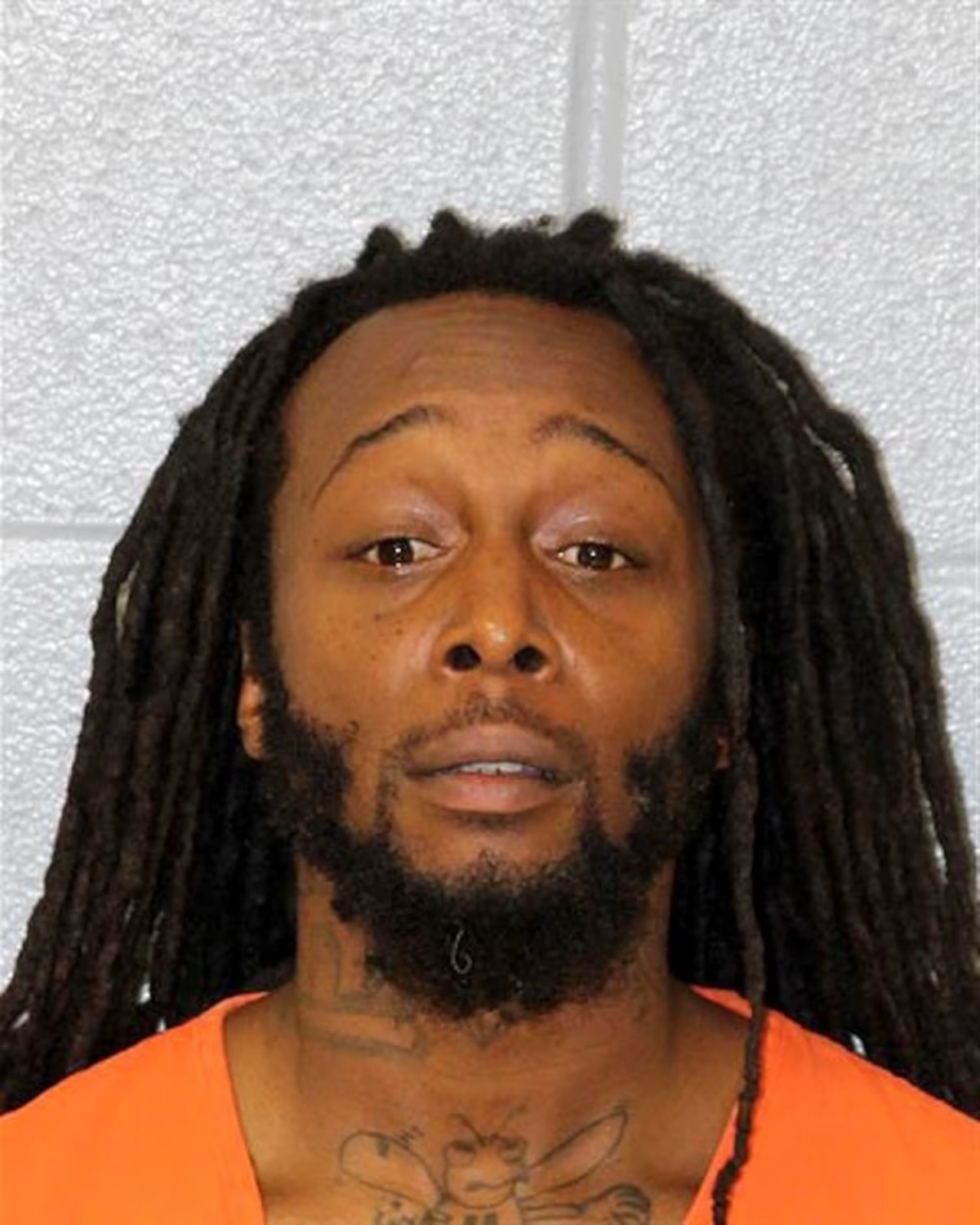
Brown was booked into the Mecklenburg County jail and taken before Teresa Stokes, a magistrate. In what was likely one of dozens of quotidian decisions that day, but has since provoked intense criticism, Stokes released Brown without bail, on a written promise to return to court. (No trial date has been set.)
Seven months later, he killed Zarutska. In audio recordings of a conversation between Brown and his sister obtained by ABC News, Brown said that a “material” in his body made him attack her. “I’m telling you, the material did it,” Brown said.
“I never said not one word to the lady at all. That scary, ain’t it? So, like, why would somebody stab somebody for no reason?” he said, according to ABC News.
He told his mother, Michelle Dewitt, “I got to go back over to the hospital, though, ‘cause they got to get that object out of my head,” according to the Charlotte Observer.
Dewitt told media outlets that after his release from prison in 2020, Brown began yelling and slamming doors. “He wasn’t the normal Carlos, the fun Carlos,” she said. She said he was diagnosed with schizophrenia and prescribed medication, but he refused to take it. (Dewitt declined an interview request with The Assembly, and Brown’s sister could not be reached.)
Fearing for their safety, his family took Brown to a mental health hospital, but it didn’t have enough beds to take him, Dewitt said. She petitioned a magistrate to have Brown involuntarily committed, and a hospital kept him for 14 days. But Brown was released to the family’s care.
Dewitt told ABC News that they soon dropped him off at a men’s shelter. In recent months, she saw Brown walking the streets.
For at least part of last year, Brown was working with an Assertive Community Treatment Team at Anuvia, a nonprofit drug and alcohol rehabilitation center in Charlotte, according to Sharpe. Those teams consist of social workers, nurses, psychiatrists, and other specialists who provide support and services to mentally ill people.
Sharpe said he doesn’t know how Brown became involved with the program, and Anuvia officials did not return a message seeking comment. It’s unclear whether Brown was involved with the program at the time of Zarutska’s death.
“I’m not making any excuse for what happened,” Brown’s sister, Tracy Brown, told ABC News. “I am saying that if he had the proper care, this wouldn’t have happened.”
‘Rush to Judgment’
During legislative leaders’ September 11 press conference, House speaker Hall lashed out at Charlotte officials, accusing them of mismanaging their public safety budget and adopting “soft-on-crime” policies that made the city dangerous.
Charlotte spends almost 40 percent of its general fund on its police department, more than most big cities. But its pay and benefits trail other law enforcement agencies, and the Charlotte-Mecklenburg Police Department has hundreds of vacancies.
In 2024, the CMPD reported 111 homicides, an increase from 89 the year before. But through August 24, homicides in Charlotte had declined by about 30 percent from the same period in 2024, according to CMPD data. Aggravated assaults, armed robberies, and vehicle crimes are also down by significant margins.
“I’m not making any excuse for what happened. I am saying that if he had the proper care, this wouldn’t have happened.”
Tracy Brown, sister of the accused killer
Per capita, Mecklenburg is not even close to North Carolina’s most dangerous county, according to N.C. State Bureau of Investigation data. In 2023, the most recent year records are available, seven counties had higher violent crime rates than Mecklenburg. Thirty-one counties, many rural and Republican-leaning, had higher murder rates—including Rockingham, Berger’s home.
Hall told reporters that Republicans would scrutinize Charlotte and Mecklenburg’s budgets and look for grants he suspected they received from anti-incarceration groups. But nothing like that appears in the draft bill obtained by The Assembly.
Berger said he wanted to prevent future governors from forming task forces that advance “weak-on-crime policies.” The powerful Senate leader, who is facing a primary challenge from a hard-right sheriff, blamed Cooper’s racial justice task force for fomenting a “willingness to pay more attention to the concerns of the perpetrators than the real concerns of the victims.”
When a reporter asked, however, Berger could not connect any of the task force’s recommendations to Zarutska’s killing.
The task force could not make policy by itself. In 2021, the General Assembly passed three reform bills addressing some of its suggestions. Many more recommendations fell by the wayside.
Cooper’s task force disbanded at the end of his administration. The draft bill forbids it from reconvening.

Berger also told reporters that he wanted to end the state’s de facto moratorium on capital punishment. The draft bill takes meager steps in that direction, requiring state courts to hear certain appeals within two years.
Mark Rabil, director of the Innocence and Justice Clinic at Wake Forest University in Winston-Salem, said that raises logistical and constitutional concerns.
“We already know that numerous innocent people have been wrongly convicted and sentenced to death in our state,” Rabil said. “No good comes from a rush to judgment.”
Litigation over this legislation could slow, rather than speed up, death penalty appeals.
This provision applies only to future murder defendants, not to the 122 people currently on death row or anyone awaiting trial. It also doesn’t affect the main reason North Carolina hasn’t executed anyone since 2006: ongoing litigation over lethal injection and the since-repealed Racial Justice Act.
One section of the draft bill wasn’t mentioned at the press conference, and has little connection to Zarutska’s killing. It aims to partially repeal a law the General Assembly unanimously passed in 2020 that expunged the records of people whose cases were dismissed or resulted in not-guilty verdicts. The law took effect in December 2021. In its first six months, court officials purged more than 354,000 criminal cases.
The court system struggled to keep up, and in 2022, the General Assembly paused expunctions for two years. But the law went back into effect last year, despite an effort by House Republicans to repeal it.
House Republicans appear to have tried again this year, using this bill as a vehicle. But the law has key Republican allies in the Senate, and multiple sources told The Assembly over the weekend that the expungement provision was likely dead.
“It is out and will not be in the final draft,” said Sen. Danny Britt, a Robeson County Republican and co-chair of the Senate Judiciary Committee.
‘Asleep at the Wheel’
In 2023, the General Assembly passed the Pretrial Integrity Act, which required judges, not magistrates, to set pretrial release conditions for certain felonies as well as most offenses committed when the defendant is already out on pretrial release.
“But it obviously was not enough,” Hall said at the press conference. He was one of the bill’s sponsors.
The issue, Hall said, is “magistrates who are asleep at the wheel, like this one obviously was,” referring to Stokes, who freed Brown without bail in January.
Some conservatives have claimed that Stokes’ purported ties to a Charlotte drug and alcohol addiction clinic—a now-deleted online profile reportedly listed her as the clinic’s director of operations—and a Michigan mental health care nonprofit she co-founded a decade ago created a conflict of interest.
The draft bill instructs the Administrative Office of the Courts to promulgate regulations regarding “conflicts of interest” for magistrates. Rules governing magistrates’ finances and charitable and civic activities already exist.
Unlike in most states, North Carolina’s magistrates do not have to be lawyers. They are appointed by the clerk of courts and supervised by the chief district judge.
U.S. Rep. Tim Moore, the Republican former state House speaker, wrote a letter to Mecklenburg County Chief District Court Judge Tim Wiggins on September 9 calling for Stokes’ removal. “By releasing a violent offender on nothing more than his written promise to appear, Magistrate Stokes displayed a willful failure to perform the duties of her office,” Moore wrote. The letter was signed by the state’s nine other U.S. House Republicans.

By law, Wiggins can suspend Stokes. But he doesn’t appear to have done so.
The draft bill allows the chief justice of the Supreme Court, currently Republican Paul Newby, to suspend any magistrate in the state—including Stokes. If Newby suspends her, Stokes will have a hearing before a Mecklenburg County superior court judge, who will decide whether to fire or reinstate her.
Despite the backlash, Stokes appears to have followed the county’s bail guidelines and state law, which usually defaults to cashless bail unless there is evidence the defendant won’t show up for court or poses a danger to the community.
Brown’s January arrest was for a non-violent misdemeanor. Even with his prior convictions, the county’s risk-assessment formula recommended that Stokes release Brown on a promise to return. As the Charlotte Observer reported, Brown was a borderline case. Had he scored slightly higher on the risk assessment, the guidelines would have called for Stokes to release him into the custody of a designated person or organization, such as a mental health nonprofit—another form of cashless bail.
Stokes chose the former option. But even if she’d locked Brown up, he would have been free long before he stabbed Zarutska. Under the state’s sentencing guidelines, he would have served a maximum of 45 days in jail.
“We already know that numerous innocent people have been wrongly convicted and sentenced to death in our state. No good comes from a rush to judgment.”
Mark Rabil, director of the Innocence and Justice Clinic at Wake Forest University
Stokes also could not have committed Brown to a mental health facility unless someone else filed an involuntary commitment petition, said state Rep. Marcia Morey, a Durham Democrat and former chief district court judge. While magistrates approve petitions for involuntary commitment brought by law enforcement or family members, they cannot initiate them on their own.
Morey wondered why some of the scorn directed at Stokes wasn’t aimed instead at the police officers who encountered Brown during what appeared to be a mental health crisis. They could have petitioned for an involuntary commitment. Or, since they were already at a hospital, they could have also asked medical professionals to evaluate him.
“Why don’t [Republicans] address a cop responding to an obvious mental health issue?” Morey asked. “Why don’t the cops do what [Republicans are] asking the magistrates to do?”
‘Collateral Impacts’
Berger and Hall have said they want to “end cashless bail,” but the draft bill doesn’t do that.
It blocks judicial officials from releasing defendants on a “written order to return”—the kind of pretrial release given to Brown in January. But they can release defendants on an unsecured bond, in which a defendant merely promises to pay a certain amount if they fail to return to court. And because the bill sets no floor, magistrates could, if local rules allowed, issue unsecured bonds for $1.
Some of the bill’s other provisions seem likely to lead to more people being jailed. That could prove problematic, as some of the state’s jails are already overcrowded.
“By releasing a violent offender on nothing more than his written promise to appear, Magistrate Stokes displayed a willful failure to perform the duties of her office.”
U.S. Rep. Tim Moore
“This is such a knee-jerk reaction to a high-profile case,” a longtime judicial official told The Assembly. The official spoke on the condition of anonymity. “I hope they’re going to provide a tremendous amount of money to counties to build jails. This is going to fill up the jails. This is going to be another unfunded mandate.”
The draft bill does not include funds for jails.
Eddie Caldwell, general counsel for the N.C. Sheriffs’ Association, said his organization would not comment until it knows “what is actually enacted by the General Assembly.” (Sheriffs are in charge of county jails.)
The bill requires judicial officials to order a secured bond or house arrest for defendants charged with a violent crime—as defined, this includes some drug charges, such as death by distribution and fentanyl trafficking. The same rule applies to anyone with three class 1 or A1 misdemeanor or felony convictions in the last decade, no matter their current charge.
This provision would not have applied to Brown in January 2025; his convictions were too old.

The bill also makes clear its preference for pretrial detention. It establishes a “presumption” that people charged with serious felonies, violent crimes, or who have criminal records should be jailed. Judicial officials who deviate will have to explain themselves in writing, and magistrates who fail to do so can be suspended.
That could raise constitutional issues since defendants awaiting trial, by definition, have not been proven guilty of their alleged crime. And the Eighth Amendment prohibits excessive bail, meaning anything that’s not necessary to protect public safety and ensure the defendant’s return to court. Blanket policies could lead to lower-income defendants being incarcerated simply because they can’t afford bail.
That was the subject of a class-action lawsuit in Alamance County in 2019. Under the settlement, the county court system had to take into account each defendant’s ability to pay.
There’s little evidence that eliminating cashless bail will reduce crime, said Kevin Peterson, a criminologist at the University of North Carolina at Charlotte. But pretrial detention has “collateral impacts.”
People jailed before trial are more likely to lose jobs and connections to their families, and to commit crimes later.
‘Loophole’
Only one of the bill’s provisions might have prevented Zarutska’s killing. It would likely have forced Brown into treatment in January, when he was arrested for misusing 911.
But the bill’s method raises civil liberties concerns.
The legislation requires judicial officials to hold defendants for a mental health evaluation under two circumstances: if they’ve been charged with a violent crime and have been involuntarily committed within the past three years, even if they’re not showing signs of mental distress; or if they’ve been charged with any crime, no matter how minor, and the judicial official believes they are “experiencing a mental health crisis.”

The draft bill does not define that term.
The hold can last for up to 72 hours. During that time, defendants would be detained—apparently in a jail—without a hearing or access to an attorney.
“When do you get the appointment of counsel?” asked Morey, the state representative and former judge. “I mean, just this limbo, the 72 hours, and then waiting for the evaluation—your liberties being denied.”
If the evaluation determines that defendants pose a danger to themselves or others, the county will petition for an involuntary commitment. Once a magistrate grants the petition, defendants will be held until space in a 24-hour psychiatric facility opens, which could take weeks. (It’s unclear whether they would wait in an emergency room, like others under involuntary commitment, or in a jail.)
Only then do they get a lawyer and, within 10 days, a hearing.
There was another moment that the courts could potentially have forced Brown into treatment, just weeks before Zarutska’s death.
On July 28, Wiggins, the district judge overseeing Brown’s misuse-of-911 case, ordered that Brown appear at Alliance Health to be evaluated for competency to stand trial within seven days. But Brown never showed, according to court records.
Wiggins could have issued a contempt-of-court order that instructed police to pick Brown up and take him to the evaluation, according to Morey. But someone—likely the prosecutor or Brown’s attorney—would have had to tell Wiggins that Brown missed the evaluation.
Court records don’t show whether anyone did, and there’s no indication that Wiggins issued a contempt-of-court order.
Had Brown been found incompetent, it’s possible he could have been pushed into treatment. Even if that only helped temporarily—or kept him off the streets a few weeks—Zarutska might still be alive.
But in a misdemeanor case, it’s more likely the charges would have been dropped, Morey said.

Last week, she and other House Democrats sent a list of recommendations for the crime bill to their Republican colleagues. One of their proposals would allow judges to appoint guardians to ensure that defendants like Brown make it to their competency evaluations.
“You’re talking about someone incompetent,” Morey said. “They may not follow up because they don’t know what is happening. That’s a loophole that maybe we could fix.”
Republicans didn’t include it in the draft bill.
‘A Broken System’
Most people with schizophrenia are not violent—in fact, research shows they are more likely to be victims than perpetrators—especially when they’re treated. But studies show that many people with schizophrenia discontinue treatment. And untreated people with psychotic symptoms “are more violent than the general population,” Dr. Steven Silverstein, an expert on schizophrenia at the University of Rochester Medical Center, told The Assembly in an email.
One recent study found that individuals with schizophrenia are about 17 times more likely to commit homicide than the general population.
Brown’s mother has said he was diagnosed with schizophrenia after his release from prison in 2020, shortly before his 30th birthday. But he likely began displaying symptoms earlier. According to the National Institute of Mental Health, the disease typically emerges in men by their early 20s.
“I never said not one word to the lady at all. That scary, ain’t it? So, like, why would somebody stab somebody for no reason?”
Decarlos Brown Jr.
Citing federal privacy laws, N.C. Department of Adult Correction spokesman Keith Acree would not say whether Brown was treated for mental health issues while incarcerated, though Acree said all inmates are screened for “mental health concerns.”
After his release, Brown’s family said they took him to a mental health facility, but it didn’t have room. They then had him involuntarily committed, but he was released after two weeks.
To be held under involuntary commitment, individuals have to be found mentally ill or impaired and present a danger to themselves or others. By law, involuntary commitments last up to 90 days, though physicians can ask courts to hospitalize patients longer.
But if patients improve to the point that they are “no longer in need of inpatient commitment,” the law says the attending physician must discharge them “unconditionally”—though in some cases, with a requirement that the patient continue outpatient treatment for a month.
Patients are often stabilized with medication, but once they’re discharged, some stop taking their meds.
The state doesn’t have enough beds for its most serious patients.
North Carolina has one of the lowest per-capita state psychiatric hospital bed rates in the country, and there’s a five-month wait for forensic beds—those reserved for mentally ill patients in the criminal justice system, according to a 2024 report from the Treatment Advocacy Center.

Together, the state’s three psychiatric hospitals have about 910 beds, but because of staff shortages, only 600 beds are in operation, according to N.C. Health News. Almost 30 percent of those beds are taken up by defendants who’ve been deemed incompetent to stand trial.
In an email to their colleagues last week, Senate Democrats proposed increasing Medicaid reimbursement rates for mental health providers to alleviate shortages, spending $50 million this year to help jails reduce overcrowding and provide mental health services to inmates, and allocating $50 million a year to create regional involuntary commitment hubs.
These hubs would have around-the-clock intake capacity and be required to have plans to help patients after they’re discharged.
“These centers would give families a place to turn when a crisis occurs, and give law enforcement a critical tool they don’t currently have,” said Sen. Caleb Theodros, a Mecklenburg County Democrat. “This is how we start to fix a broken system.”
The draft bill doesn’t include any of their suggestions.
Instead, the bill instructs the North Carolina Collaboratory, a research funding agency based at the University of North Carolina at Chapel Hill, to study mental health and the justice system.
The bill’s language about the study’s parameters and goals is vague. Somewhat incongruously, as part of the same study, the Collaboratory is also supposed to research “the availability of house arrest.”
The Collaboratory’s preliminary findings would be due in April 2026, and its final report in March 2027.
‘This Dance of Life’
The brutality of Zarutska’s killing fit the Trump administration’s depiction of Democratic-run cities—especially Democratic cities with Black mayors, like Charlotte—as overrun by “bloodshed,” despite the national violent crime rate falling to its lowest level in two decades last year.
“For far too long,” Trump said from the Oval Office on September 9, “Americans have been forced to put up with Democrat-run cities that set loose savage, bloodthirsty criminals to prey on innocent people. … In Charlotte, North Carolina, we saw the results of these policies.”
That day, federal prosecutors charged Brown with committing violence on a mass transportation system, a terrorism charge that carries a potential death sentence. Brown was already facing a first-degree murder charge in state court, which can also be a capital crime.

Trump later posted on social media that Brown “should be given a ‘Quick’ (there is no doubt!) Trial, and only awarded THE DEATH PENALTY. There can be no other option!!!”
A trial is unlikely to happen soon. Brown is being held at Central Regional Hospital in Butner, where doctors are evaluating his competency to stand trial. That process will likely take at least several months. He is scheduled to appear in Mecklenburg County Superior Court on October 16 for a hearing to determine whether state prosecutors can seek the death penalty.
Even if he’s deemed competent, capital cases take years to reach a jury—and longer in Mecklenburg County, where the critically understaffed DA’s office is still trying homicides from 2020.
Federal prosecutors could bring their case first, but experts say Brown’s mental illness will complicate efforts to obtain a death sentence.
Meanwhile, the political reaction to Zarutska’s death will continue. Brown’s unsettling mugshot, with his long dreads and haunted eyes, will become a familiar sight in campaign ads, as will images of Zarutska’s final moments.
Lost will be the life Zarutska never got to live—her dreams, her passion for art, the future she was building after fleeing a war.
At her funeral last month, her cousin Vera Falkner said that’s what Zarutska would want people to focus on.
“She would want you to dance or listen to music, smoke a cigarette—do something,” Falker said, according to the Charlotte Ledger. “Paint something. Kiss a flower. This dance of life is so fragile.”
You must be logged in to post a comment.