


The General Assembly may be quiet this week, but the news outside the building wasn’t. Let’s get into it.
— Bryan Anderson
🧑⚖️ Roll Call
- Trump sues the State Board of Elections
- Tough tax revenue predictions
- The Tuscarora’s fight for recognition
On a Voter Roll
The Trump administration this week filed a lawsuit against the North Carolina State Board of Elections, asking a federal court to give elections officials 30 days to address and correct missing information in its voter registration database.
In so doing, the U.S. Department of Justice gave Republican state officials, who took control of the NCSBE earlier this month, added cover to pursue a voter roll cleanup effort that they were already planning to undertake.
At issue here are thousands of voters without their driver’s license number or last four digits of their Social Security number in the voter-registration database. The 2002 Help America Vote Act requires voters to provide that information when they register.
A little bit of history:
- In 2023, conservative activist Carol Snow brought attention to a state voter registration form that appeared to make providing a Social Security number or driver’s license number optional. The NCSBE, then overseen by Democrats, corrected that form but declined to honor Snow’s request to proactively verify the identity of the estimated 225,000 registered voters who had used the old one.
- The Republican National Committee sued the NCSBE months before the 2024 election to remove those 225,000 voters from the rolls. U.S. District Court Judge Richard Myers, a Trump appointee, rejected part of that lawsuit.
- After the 2024 election, Republican Court of Appeals Judge Jefferson Griffin unsuccessfully challenged his defeat in a state Supreme Court race by seeking to throw out ballots cast by 60,273 voters whose driver’s license numbers or Social Security numbers weren’t in the NCSBE database.
Griffin ultimately lost that fight, but a majority of justices on the state Supreme Court had some choice words about how the NCSBE had handled its record-keeping and strongly suggested it needed to take corrective action.
“The Board’s inattention and failure to dutifully conform its conduct to the law’s requirements is deeply troubling,” wrote Chief Justice Paul Newby and Justices Tamara Barringer, Phil Berger Jr. and Trey Allen, all Republicans.
Now, with a new GOP-led State Board of Elections (more on that in a minute) and fresh pressure from President Donald Trump, Republicans are hoping for the state to address data management issues, which could ultimately result in some voters being removed from the rolls.
“We are in full support of this effort to clean up North Carolina’s voter rolls and finally fix the problems that have plagued the NCSBE for years,” NCGOP chairman Jason Simmons wrote on X.
Democrats, meanwhile, are pushing back.
“North Carolina Democrats will remain vigilant in our fight against Trump and the Republican Party’s agenda to deny democracy in this country,” NCDP Chairwoman Anderson Clayton wrote on X. “We will be prepared to re-register voters, litigate this fight in the courts, and win by a greater margin in ‘26 than we did in ‘24.”
GOP Still in Charge
In other news, the state Supreme Court decided along party lines last week to allow Republicans to maintain control of the State Board of Elections. So no news is good news for the GOP.
As a reminder, the GOP-led General Assembly passed legislation shifting the ability to appoint state elections board members from the governor to the auditor, currently Republican Dave Boliek. Democrats are suing to overturn that law, but the state’s highest court said the Republican-majority board that Boliek picked can stay in charge while the litigation plays out.
In their order, most of the Republican justices wrote that “the constitution grants the General Assembly broad authority to reorganize the executive branch.” Democratic Justices Anita Earls and Allison Riggs dissented. Republican Justice Richard Dietz agreed with the court order, but gave a more nuanced take.
Representatives for Democratic Gov. Josh Stein didn’t respond to a request for comment.
Meanwhile, Republican lawmakers appear to have successfully given their party control over elections. Starting June 25, North Carolina’s 100 county elections boards will begin seeing similar shifts from 3-2 Democratic boards to 3-2 Republican majorities.
— Bryan Anderson
Finance Friday
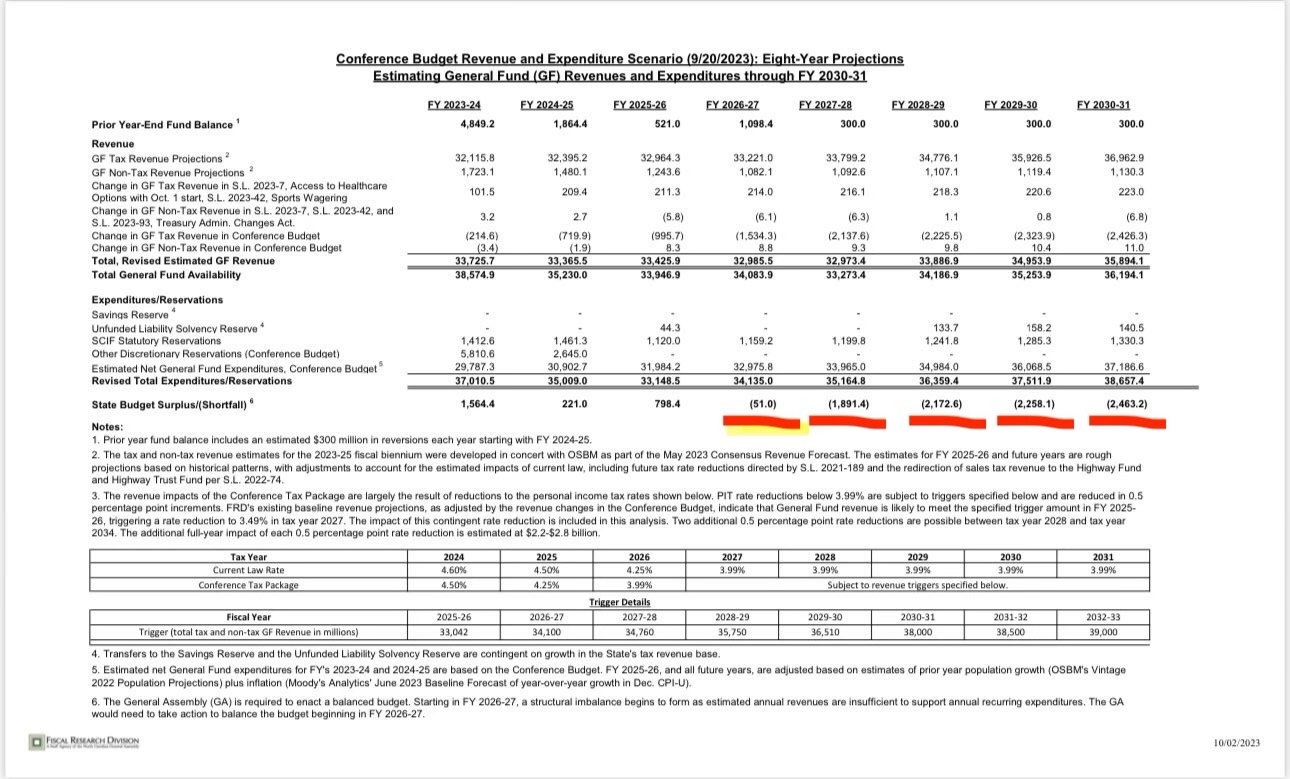
A new report from nonpartisan budget analysts in the North Carolina General Assembly’s Fiscal Research Division and the Office of State Budget and Management shows the state’s financial future appears weaker than it did three months ago.
The analysts said they “modestly” downgraded their expectations of how much the state will generate in tax revenue in this fiscal year and the next two.
This year, the report said, estimates were revised down from a February report because of lower-than-expected corporate tax collections. Analysts attributed that to “higher input costs and lower profits from recently implemented tariffs.”
For the upcoming biennium, the analysts said they revised down their expectations due to lower sales, individual income, and corporate tax revenues. They expect lower personal income tax revenue because fewer businesses plan to raise wages, which could also lead to lower sales tax revenues as consumers change spending habits. The report projects lower tax revenue in 2026-27 than in 2025-26 because additional personal income tax cuts are set to kick in.
Stein has called on lawmakers to freeze already approved tax cuts for businesses and individuals.
State Budget Director Kristin Walker has likened the state’s financial position to the 2008 financial crisis.
“I have never seen a situation where the revenue is less in the second year of the biennium than in the first,” Walker said in a March 19 news conference. “Truly, you have to go back to the Great Recession…This is unprecedented.”
In 2023, the Fiscal Research Division provided lawmakers with an internal report laying out an eight-year roadmap. Under those estimates, North Carolina would see a nearly $2 billion annual deficit starting in the 2027-28 fiscal year.
Republicans see fears of an approaching fiscal cliff as overblown. Even so, the two GOP-led chambers have different levels of concern. The two-year spending plans from both the House and Senate budget maintain the corporate tax cut reductions (which are scheduled to phase out by 2030) and keep in place a planned personal income tax reduction for the 2026 tax year from 4.25% to 3.99%. But what happens after that remains in limbo.
House Republicans want to hit the pause button on personal income tax cuts, leaving the 3.99% tax rate in place for 2027 unless the state hits a more ambitious revenue target (which it’s not on track to achieve). The Senate budget would go forward with an already agreed upon tax cut to 3.49% in 2027.
Senate Republicans want to automatically reduce the tax rate to 2.99% in 2028, regardless of how much money the state takes in. Subsequent reductions to as low as 1.99% would be dependent on revenue targets being hit.
Stein favors the House proposal, which he said created “more fiscally prudent triggers that must be satisfied before the cuts go into effect.”
— Bryan Anderson
Thanks for reading The Caucus, a politics newsletter anchored by Bryan Anderson. Reach us with tips or ideas at politics@theassemblync.com.
Did someone forward this to you? Sign up here to get The Assembly’s twice-weekly politics newsletter.
For the Tuscarora, Tradition and Politics Clash in Quest for State Recognition
Self-governance has always been important to the Tuscarora, who have been in the Carolinas for more than 2,000 years. But Rep. Ed Goodwin said the tribe would have a better chance of winning state recognition if it formed a central government with a tribal chairman and council members. That setup would identify one leader to speak for the entire tribe and eliminate squabbling among longhouses.
With help from Goodwin’s legislative assistant, Richard Blackwelder, some tribal members established the Tuscarora Indians of Kahtenuaka Territories in February. The group is structured as a “nation of individuals,” meant to unify all 1,200 or so Tuscarora people across the state.
Leaders of the Maxton, Prospect, and Saddletree longhouses initially agreed to take part in the unification process and the new government. But they ultimately opted out, saying the group had veered too far from tradition and sown distrust.
— Sarah Nagem
Let us know what’s on your radar at politics@theassemblync.com.


You must be logged in to post a comment.