


|
Getting your Trinity Audio player ready...
|
Update: The U.S. Attorney General’s Office for the Western District of North Carolina issued a statement, emphasizing that Brown remains in federal custody and that the state proceedings, including competency hearings, are “completely separate.”
Also, Emma Hall, a Republican National Committee spokeswoman, released a statement blaming former Gov. Roy Cooper, a U.S. Senate candidate, for releasing Brown early through a 2021 lawsuit settlement: “It is shameful that Roy Cooper continues to dodge accountability for the role he played in helping release this monster and for his record that turned North Carolina into a haven for violent criminals.”
As we’ve previously reported, that allegation is false: Brown was not released early.
DeCarlos Brown, the man accused of fatally stabbing a Ukrainian refugee last year in a Charlotte light rail train, has been deemed mentally incapable of proceeding to trial, according to a court document.
On Tuesday, Brown’s attorneys filed a motion in Mecklenburg Superior Court seeking to continue what is known as a Rule 24 hearing, in which a judge determines whether prosecutors can pursue the death penalty. Brown was evaluated at Central Regional Hospital, a state psychiatric hospital in Granville County, in December after his attorneys expressed concerns about his mental state.
A December 29, 2025 report indicated that Brown was “incapable to proceed to trial,” according to the motion filed by one of his attorneys, Daniel Roberts. The next step will be a capacity hearing in Mecklenburg Superior Court at which a judge will determine if Brown should stand trial. Roberts said in the motion that the hearing can’t happen while Brown is in federal custody.
In addition to first-degree murder, Brown also faces a federal charge alleging he committed an act of violence resulting in death on a mass transportation system. State and federal prosecutors are seeking the death penalty.
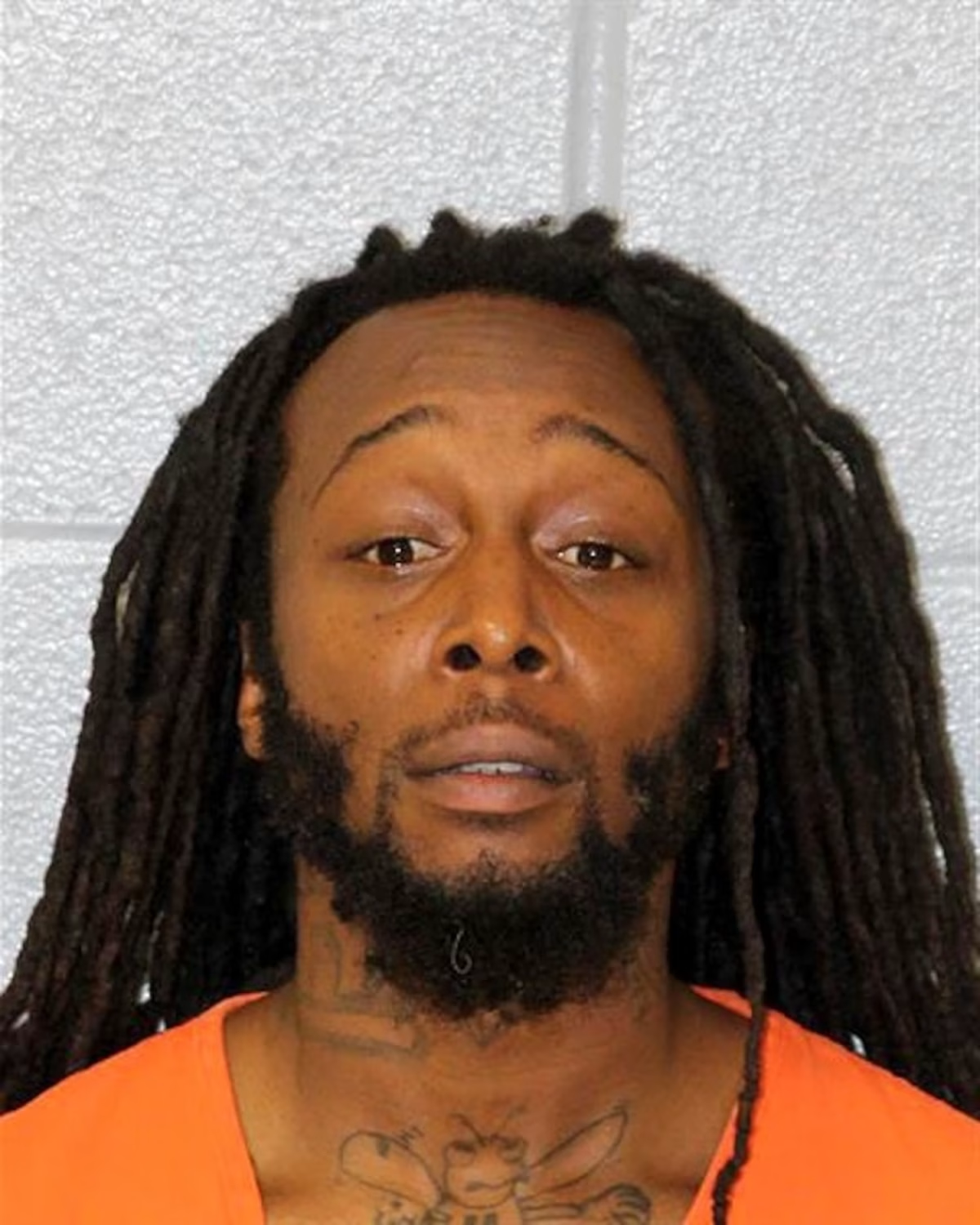
The evaluation of Brown is a significant development in a case that has grabbed national headlines and has been used by Republicans to blame Democrats for being soft on crime. Surveillance cameras in August 2025 captured the brutal stabbing of Iryna Zarutska, 23, who had come to the United States from war-torn Ukraine. That September, the footage was publicly released and went viral, reaching all the way to the White House.
In February, President Donald Trump invited Zarutska’s mother to the State of the Union, where he called Brown a “deranged monster” and falsely claimed that he “came through open borders.” (Brown was born in Charlotte.) That same month, the N.C. House Oversight Committee held a hearing in which Republican legislators lambasted Charlotte leaders over Zarutska’s death.
After her death, the Republican-led General Assembly passed a bill named for her, and Gov. Josh Stein, a Democrat, signed it last year. Among other things, the new law restricts pre-trial release and seeks to revive the long-dormant death penalty.
Roberts asked for the Rule 24 hearing to be continued for six months. A judge has not yet ruled on the motion.
Brown is undergoing a separate psychological evaluation in the federal prison system. A report from that evaluation is expected later this month. If Brown is deemed mentally incompetent to stand trial, a judge will have to hold a capacity hearing in federal court. The state case is also at a standstill while Brown is in federal custody. Brown won’t go to trial in either court until questions surrounding his mental state are resolved.
Brown, 35, had a long history of mental illness that seemed exacerbated in the last year before Zarutska was killed. He had been in and out of the criminal justice system, mostly for minor crimes such as breaking and entering and shoplifting.
His most serious crime was armed robbery, for which he served a 73-month sentence. There were other arrests indicating potential violent tendencies, such as an alleged assault on his sister, but none led to convictions.

Starting in 2024, his interactions with Charlotte-Mecklenburg police suggested he was spiraling into a mental health crisis.
On April 21, 2024, officers were dispatched to the Novant Health Presbyterian Medical Center five times because a “schizophrenic individual”—Brown—kept calling 911, according to an incident report. That night, Brown moved a couple of blocks away and continued to call 911, “requesting help when it was not needed,” according to the incident report. Police arrested him for misusing the 911 system, a misdemeanor.
Two weeks later, Brown was arrested again for repeatedly calling 911 from outside the Charlotte police headquarters.
Dillon Sharpe, an attorney who represented Brown, told The Assembly that prosecutors took one of those cases to trial, where Brown was found not guilty. The other charge was dismissed, Sharpe said.
In January 2025, police again went to Novant Health Presbyterian Medical Center, where Brown had been repeatedly calling 911. According to a charging document, Brown told officers that “he believed someone had gave him a ‘man-made’ material that controlled what he ate, walked, talked, etc. Brown wanted officers to investigate this ‘man-made’ material that was inside of his body.”
When officers said they couldn’t help him, Brown called 911 again and asked to speak with different officers. Police again arrested him for misusing 911. That charge is pending.
You must be logged in to post a comment.