


|
Getting your Trinity Audio player ready...
|
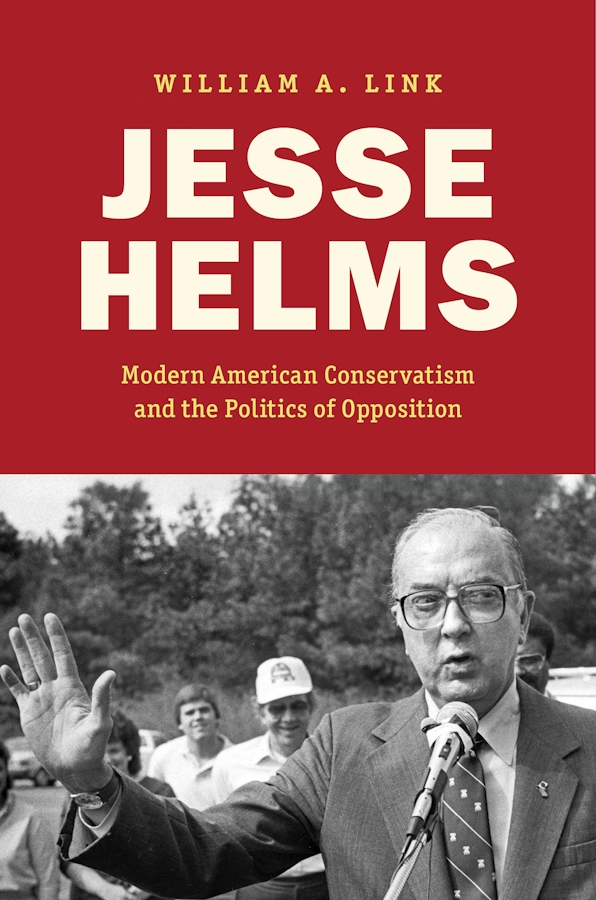
Link is the author of Jesse Helms: Modern Conservatism and the Politics of Opposition. He will discuss his new book with Western Carolina University political science professor Christopher Cooper and The Assembly’s John Drescher at 6 p.m. on April 21 at Flyleaf Books in Chapel Hill.
These excerpts are published with permission from UNC Press.
In early January 1973, Joe Biden, a newly elected, 30-year-old U.S. senator from Delaware, was sworn in along with Jesse Helms and 10 others. A moderate Democrat, Biden soon developed an unfavorable opinion of Helms, the first Republican elected to statewide office in North Carolina since 1898.
After complaining to Senate majority leader Mike Mansfield that Helms had “no social redeeming value,” Biden changed his opinion when he learned that Helms had adopted a 9-year-old child, Charles, who suffered from cerebral palsy. Feeling like “a fool,” Biden learned his lesson. “From that moment on,” he later declared, “I tried to look past the caricatures of my colleagues and try to see the whole person.”
“For all the intensity with which he takes on issues, for all the depth of his feelings about issues that are so socially highly charged—left and right,” Biden added, Helms was “a man who has a very, very soft side.” Although some of his “more combative Democratic friends might be skeptical of me,” Biden said, “they don’t know Jesse Helms like I do.”
Helms’s staffers remained devoted to him over the years, and not just because they shared his conservative ideas. Elizabeth Siefert, who worked as a Senate aide in the 1990s, described how Helms ran his office. He gave legislative aides like Siefert considerable autonomy. She found the senator “open and solicitous” in his dealings with staff; he was a “terrific boss, incredibly giving boss.”
Working in Helms’s Senate office, she recalled, was “like being in a family.” When Helms learned about Siefert’s mother’s birthday, he asked for her phone number so that he could call her. In his office, he liked to line the wall with cartoons making fun of him, in particular those from the Raleigh News & Observer. Siefert concluded that Helms usually enjoyed political combat with his enemies.
Helms has often been underestimated by his adversaries and by historians, often parodied as an inept Southern buffoon. The reality was far different. He was an able rhetorician, skilled at communicating a populist, anti-elitist message. Understanding the power of words and images for ordinary Americans, Helms was especially effective at using modern broadcasting media.
At their peril, many of his political opponents ignored his facility with language and clever argumentation, and his ability to connect with North Carolinians and conservatives nationally. A conservative senator described Helms as having “an innate craftiness and cleverness that’s stunning to watch … You can’t box him—he’ll defang you when you get close. Anyone who sells him short is going to lose—and has. He’s amazing and formidable.”
These diverse yet similar experiences were not unique: Helms was a complicated politician who was harsh in public and often gracious in private. Contemporaries, even some liberals, encountered more complexity in his political personality.
Jack Betts, who wrote for the Greensboro Daily News and the Charlotte Observer, was an undergraduate at UNC-Chapel Hill during the 1960s. He remembered that he and his dormmates watched broadcasts of Helms’s TV editorials, which “we thought … were hilarious.” But Betts, living inside the Chapel Hill bubble, later admitted that he had underestimated Helms’s connection with ordinary North Carolinians.
“You can’t box him—he’ll defang you when you get close. Anyone who sells him short is going to lose—and has.”
fellow conservative senator
Indeed, the more time reporters spent with Helms, the more they found him complex, even charming. Although Helms “could be prickly” with the press, Betts often found him to be “warm and engaging.” In private exchanges, he was often “courtly and polite,” but he could also cut off a “piece of meat while smiling at you.” Betts noted that “it was fun to cover him” when he reported on Helms in the 1970s, because he “stirred so much passion” among supporters and opponents that “you always got a good story.” Betts noted that people often made the mistake of dismissing Helms as an “unlettered rube.”
Without question, Helms’s political style was polarizing and defined political divisions that persist today. A sympathetic conservative, Human Events editor M. Stanton Evans, described him as “the soul of Southern courtesy—soft spoken, polite,” and whose “main concern appears to be to put the person he is with at ease.”
Helms’s “soft” side disguised a political ruthlessness. Among modern conservatives, he paved the way with his brutal style of campaigning, with his relentless pursuit of what came to be known as culture wars, and as a tactician who used the Senate as a podium to rally a national constituency.
What remains is a contradiction between Helms’s commitment to public morality and his willingness to do whatever it took to communicate his message and, in elections, whatever it took to win. The contradiction verges on hypocrisy; Christian love was not practiced in his brutal world of politics.
Small-Town Ethos
Helms used race and sexuality to harvest political power out of white fears about the decline of white supremacy and changes affecting the family. He vigorously defended the racial status quo of the Jim Crow era and attacked the Black-led civil rights movement and its liberal white allies.
His political rhetoric tapped into this powerful, often tribal response of white Southerners—but without the rough edges of 1950s and early 1960s segregationists.
At the same time, his main appeal to North Carolina voters and his national constituency was his honesty and adherence to traditional moral values. In my 2008 book Righteous Warrior, I intended to avoid the ideologically charged caricatures of the right and left and instead endeavored to understand and assess Helms’s impact during the last third of the 20th century. Writing a biography of a living person was risky, but especially so when the old wounds that Helms inflicted still festered.

As a result, this book enjoyed the approval of neither side of the polarized political environment. Many of my colleagues were and are astounded that anyone could abide writing such a book. At the same time, Righteous Warrior was written without the approval of Helms and his supporters, though I interviewed many of them. Once the book was published, some of them complained loudly about what they thought was unfair treatment of Helms, especially on matters of race. Nearly two decades after his death, Helms continues to polarize those who remember him.
There are few figures more important than Helms in the emergence of modern conservatism, more forceful in articulating an ideologically charged agenda, more effective in fashioning a message with wide popular appeal, and more successful in implementing a political strategy to gain power. He led an important transformation in late 20th century American politics in which a deep political polarization remade the electoral landscape.
Beginning as a newspaper reporter, after World War II Helms became a radio broadcaster. After working in the bruising 1950 North Carolina Senate campaign and a brief stint as a congressional staffer, Helms worked for the North Carolina Bankers Association and in 1960 moved into television and ran WRAL, then Raleigh’s leading TV station. With his broadcasting background, he developed a keen notion of how to market political ideas using modern media. He thoroughly understood how to reach people and communicate in terms that they understood.
From 1960 to 1972, Helms became a television editorialist, commanding a wide following in North Carolina, especially in the eastern third of the state. Among modern conservatives, no other major figure in this era demonstrated the cunning racism, Christian cultural outrage, organizational abilities, and political savvy in one man as clearly as did Helms, whose life’s work sought to upend the political status quo in America. He became an anticommunist conservative during the 1950s and ‘60s, opposed the further expansion of federal power, supported a reversal of New Deal policies in labor, agriculture, and social welfare, and criticized the leftward shift of national politics. His preferred methods of attack—sabotage, figurative bomb-throwing, and the use of Senate rules—manipulated the legislative process to feed red meat to an increasingly angry political base.
“They don’t know Jesse Helms like I do.”
Joe Biden
Helms internalized the small-town ethos of the South of the 1920s and ‘30s, an ethos that included white supremacy and a strict moral code. In this sense, he was little different from most white Southerners of his generation.
Helms was a determined opponent of civil rights and the African American movement to upend white supremacy. In his five Senate campaigns between 1972 and 1996, he attracted remarkably few African American votes, even for a Southern Republican.
In 1954 and after, he opposed the U.S. Supreme Court’s Brown v. Board of Education requirement that segregation in public schools end. He also loudly opposed the Civil Rights Act and Voting Rights Act of 1964-65. Throughout his career—in striking contrast to other segregationists such as George Wallace and Strom Thurmond—he never wavered in his assessment of the Civil Rights Act of 1964.
While opposing the Black freedom movement, Helms also waged a culture war against the 1960s sexual revolution and the apparent triumph of secularization in American public life. The civil rights movement was lawless, he claimed, and reflected the moral decline of the sexual revolution, as were sit-ins, campus revolt, women’s liberation, and other protest movements incorporating the tactics of the civil rights movement. Helms consistently connected “immorality” with civil rights leaders—especially Martin Luther King Jr.—to undermine public support.
In addition, Helms turned to political messaging that was rooted in fears of change in late 20th-century gender and sexuality. Beginning in the 1970s, he sponsored the mobilization of Christian evangelicals, a group that had long remained politically inactive. He used issues such as school prayer, abortion, nonprofit status for private Christian schools, gay issues, and the general rubric of “secular humanism.”
The organization of the Moral Majority in 1979 and the Christian Coalition about a decade later at least partly occurred under Helms’s sponsorship, and in North Carolina the mobilization of Christian evangelicals formed a crucial part of his electoral strategy. Raised in a conservative Southern Baptist tradition, Helms held traditional Christian values: His conservatism was rooted in Protestant fundamentalism. He had little trouble communicating with conservative evangelicals because he spoke their language, and by the late 1970s he had become their most important leader in the Senate.
By the 1980s, Helms aggressively used antigay rhetoric as a weapon in his political messaging. An open opponent of LGBTQ rights, Helms embraced homophobia as a cultural issue. In particular, he used the AIDS crisis to demonize gay people and firmly opposed expanding federal research into defeating the disease.
Helms joined the U.S. Senate in 1973 on the heels of a rightward turn in American politics, and he occupied a prime seat in this political transformation. The Senate provided a stage for him to communicate his conservative message. He earned a reputation as “Senator No”—a designation that he eagerly embraced—because of his obstructionist parliamentary tactics that led to few victories but brought the public spotlight on conservative issues. These tactics forced his liberal opponents in the Senate to engage in recorded votes, and he used their votes against them in subsequent elections.
Rarely did Helms achieve legislative victory. In the 1970s he had little interest in enacting legislation or making policy. Rather, his political strategy was to publicize issues and mobilize a national conservative constituency. After Ronald Reagan’s election as president in 1980, Helms became the American right’s leading congressional spokesperson. During the subsequent 12 years of Republican control of the White House, he usually occupied the right flank, fighting pragmatists and insisting on ideological purity. During the early ‘80s, he promoted the conservative political agenda regarding school busing, school prayer, and abortion.

Helms rallied his conservative constituency not only because he possessed the forum of the Senate but because he assembled a formidable political machine that succeeded in fundraising, using broadcast media, and communicating a compelling political message.
The National Congressional Club, founded in 1973, supplied the muscle for Helms to win elections and to become a national conservative leader. It pioneered new methods of political communication. The Club attracted an assortment of committed conservatives, youthful ideologues, and most important, creative innovators in a new style of politics that depended on opinion polls, targeted political advertising, and slash-and-burn attacks.
Between 1978 and 1990, the Club became a full-time operation fighting for the conservative revolution. The Club and Helms became known for their bruising, take-no-prisoners political style that relied on character attacks and negative advertising.
Helms’s political advertising also relied on wedge issues to divide the electorate, most especially with issues emphasizing race and sexuality. His political organization pioneered these techniques, which were widely duplicated by political managers on all sides of the ideological spectrum across the country.
Return to the Past
In many respects, Helms’s political career is crucial for understanding the evolution of modern conservatism, Donald J. Trump, and MAGA Republicanism. Both Helms and Trump urged a return to a past in which white men were dominant.
By the end of the 20th century, a large wealth gap separated the older industrial and agricultural areas from those driven by knowledge-based technology and finance. Today, the gap is particularly evident in North Carolina in the contrast between the Raleigh-Durham megalopolis, where tech and finance have thrived, and the hinterlands of central North Carolina, where a dying manufacturing plant has left a deindustrialized core. Appeals to traditional morality and the decline of the patriarchal family resonated in this world. In those hinterlands is where Trump thrived, securing just enough support from a mobilized and energized base for narrow victories, employing the same playbook that Helms used.

Well beyond his retirement in 2002 and his death in 2008, Helms paved the way for the Trump era. Though Helms would have been scandalized by Trump, the two men shared many political attributes. Trump tapped into many of the same fears and prejudices that sustained Helms and his political machine. Both Helms and Trump relied on populist rhetoric that demonized liberal elites for what they portrayed as imposing alien cultural values. Both greatly relied on the use of attack politics through heavy television advertising that coalesced a national conservative constituency.
Like Trump, Helms belittled his opponents to feed his base in North Carolina and nationally. Like Trump, he had little interest in political moderation and instead fanned political divisions. And like Trump, Helms won by narrow margins, and his strategy depended on his fully aroused supporters. A majority of North Carolina voters admired Helms’s tenacity, and they sent him to the Senate five times. Conservatives nationwide relied on him to energize the movement. His life charts the emergence of modern American conservatism.
Helms both capitalized on and drove the polarization that fueled Trump’s rise. Helms relied on support from the state’s small towns and countryside, but he also attracted urban and suburban support in areas containing older industries, such as the swatch of North Carolina cotton textile and furniture factories that underwent deindustrialization during and after the 1970s.
Like Trump, Helms had a political base of working-class voters, and as the News & Observer’s Rob Christensen puts it, “race always was a good way” to connect with his supporters “because it worked.” This “white tribalism” became an effective way of winning elections. While Helms was “pretty shrewd” politically, Christensen said, these racial attitudes were “something deep in his bones.”


You must be logged in to post a comment.