


|
Getting your Trinity Audio player ready...
|
This story is published through our partnership with NOTUS.
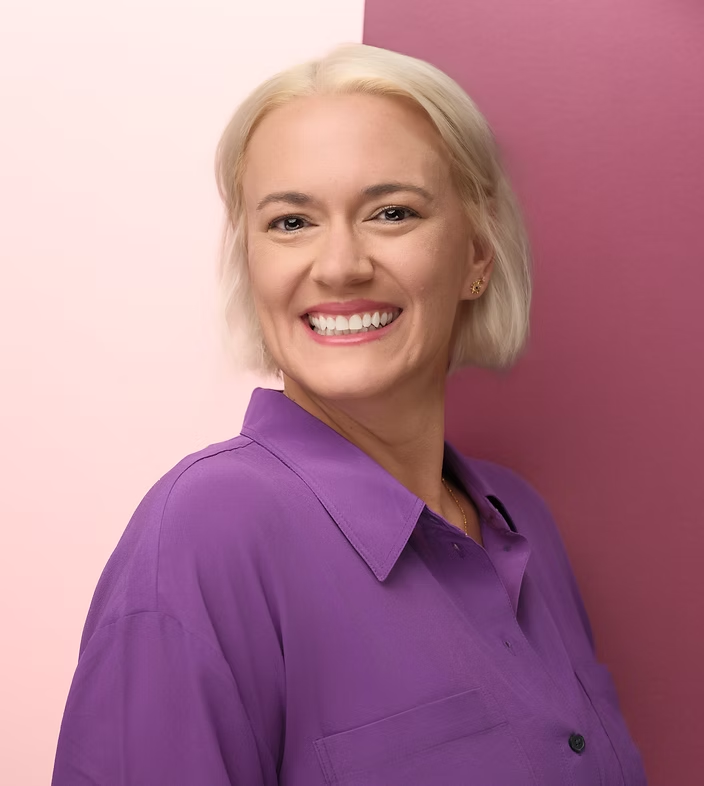
Kate Barr, a Democrat from North Carolina, sees just one viable way to be elected to Congress: running as a Republican.
Barr is challenging Republican Rep. Tim Moore for his seat in the suburbs of Charlotte, a district that the Cook Political report considers “Solid Republican.”
Her bid is serious, she says. And she wants candidates in other gerrymandered states to adopt her strategy, too. “That’s part of why we’re trying it,” she said.
The national redistricting battle is making more districts in the country effectively noncompetitive. North Carolina’s current congressional map is drawn to favor Republican voters in 10 of its 14 districts. The state passed a new map last month for 2026 that advantages Republicans along the state’s coast—a district currently represented by a Democrat, Rep. Don Davis.
States like Indiana, Texas, Ohio, and Missouri are heeding President Donald Trump’s call to secure the House majority through new congressional maps. Democrats are jumping into the fray, too. Last week, California voters approved doing their own redistricting to counter Republicans.
Barr’s campaign is both a longshot and a sign of the times. There’s been a growth in unorthodox campaigns in recent cycles. More independents are running, and gaining momentum, across the country. Political strategists attribute this to dissatisfaction with both parties. Barr is part of this trend, they say.
“This is a moment where we need a wider range of candidates that are taking creative and unorthodox approaches, whether that is independents running and shedding partisan labels entirely like you saw with Dan Osborn in Nebraska, and like I think we’ll see with an increasing number of candidates, or people with heterodox views like Kate Barr, deciding to change their partisan affiliation and running in primaries instead of general elections,” said Asher Hildebrand, a former Democratic operative and a professor of public policy at Duke University.
Barr ran for a seat in the statehouse in 2024 with the slogan “Kate Barr Can’t Win.” She embraced her inevitable failure to call attention to the state’s gerrymandered map. She lost, badly. This time, she’s actually trying to win.
“Part of the reason we’re calling this campaign ‘Kate Barr Can Win’ is because it is actually as ridiculous that I can win in a Republican primary as when I couldn’t win in a general election,” Barr said.
She’s also established a 501(c)(4) nonprofit, the Can’t Win Victory Fund, which she said is helping candidates in other states run a “Can’t Win” campaign like she did last year. Barr said 250 people have told the nonprofit they’d also like to run to lose. They are planning on creating a Super PAC at the beginning of 2026.
“Part of the reason we’re calling this campaign ‘Kate Barr Can Win’ is because it is actually as ridiculous that I can win in a Republican primary as when I couldn’t win in a general election.”
Kate Barr, candidate for U.S. House
The fund’s website says the “cant-idates” joining her protest campaign movement would receive a “sizeable donation” from her fund and “training from experienced political consultants and political losers.”
As for her own race, Barr’s campaign estimates that she needs 33,000 votes to win. North Carolina has closed primaries, meaning for Democrats to vote for her, they’d have to switch their party affiliation. But Barr says she has a shot at turning out the roughly 38 percent of voters in the district who are registered as unaffiliated and can vote in either party’s primary.
Barr also said that she’d rather be on the ballot in March than November because she expects voter suppression to worsen during the midterms. “We have to win where we can, while we can, as soon as we can,” she said.
Barr declined to share with NOTUS how much money her campaign has raised ahead of the first reporting deadline.
North Carolina Republicans shrugged off Barr’s approach. A spokesperson for Moore’s campaign called Barr’s run a “stunt” that “is an insult to Republican voters. Folks know a far-left fraud when they see one.” Matt Mercer, communications director of the NCGOP, also called the campaign “insulting.”

Reilly Richardson, a spokesperson for the National Republican Congressional Committee, said: “Kate Bar [sic] is an out of touch Democrat whose Congressional campaign is nothing more than a personal vanity project. Bar’s radical policies have no place in North Carolina, and she has no chance of beating Congressman Moore.”
The Democratic Congressional Campaign Committee did not respond to NOTUS’ request for comment.
Republicans in the state are willing to celebrate some Democrats switching parties. Democrats “realize the socialist leadership infecting the party no longer represents them,” Mercer said. Three county commissioners in Robeson County and the longtime Democratic sheriff in New Hanover County switched to the Republican party this year. The most infamous convert is state Rep. Tricia Cotham whose flip in 2023 gave Republicans a supermajority in the state House.
Barr’s switch, however, isn’t because her politics have changed.
She’s still a Democrat. But if elected to Congress, she said she plans to advocate for policies that have bipartisan support, like fair congressional maps, a $20 minimum wage, and no federal income tax on the first $100,000 that anyone earns.
While incumbents have advantages like greater fundraising and political legacy, Hildebrand said there is always the chance that an “anti-incumbent mood” strikes the electorate.
“Just to dismiss [Barr’s campaign] as a gimmick or a stunt would probably overlook a lot of those trends that could create an opening for somebody like her,” he said.
The North Carolina Republican primary is scheduled for March 3, 2026. Brent Caldwell, a Charlotte attorney, is running as the Democratic nominee.
You must be logged in to post a comment.