


|
Getting your Trinity Audio player ready...
|
In 2013, Jean-François Gariépy, a postdoctoral neuroscience researcher at Duke University, set out to find funding for a fledgling project in public science education. In cold emails to potential donors, he described his vision for NEURO.tv, a YouTube series that would feature discussions with prominent scientists about their research.
Only one recipient wrote him back, according to Gariépy.
“I will fund send details,” wrote Jeffrey Epstein, the financier and convicted sex offender. Epstein told his accountant 12 days later to send Gariépy $25,000 from his foundation.
The latest release of federal investigative documents related to Epstein have revealed a litany of academics from top universities, including Duke, who ventured into Epstein’s orbit even after he pled guilty in 2008 to two charges of soliciting prostitution, one involving a minor. He was arrested on federal sex-trafficking charges in 2019, and died by suicide in jail that year.

Some professors who appeared in the files have said they regret turning to Epstein for research funding. Gariépy does not.
Gariépy, 41, left Duke in 2015 and two years later became a full-time right-wing YouTuber. Since then, he has appeared with white nationalists Richard Spencer and Nick Fuentes on the channel that previously hosted NEURO.tv. He now livestreams a daily political commentary show from Alberta, Canada.
In a phone interview with The Assembly, Gariépy said he knew of some sexual misconduct allegations against Epstein when he solicited the donation, but believed they were exaggerated or false.
After Epstein funded the project, Gariépy wrote in a lengthy X post last year, “I then set my mind on an idealistic goal that seems ridiculous today: I would attempt a rapprochement with Epstein with the goal of convincing him to lead a monogamous marriage lifestyle. … I think I could have succeeded if the feds hadn’t gotten to him before I could.”
Science Star
At the time of NEURO.tv’s inception, YouTube was an emerging source of educational content.
Gariépy’s goal, according to the solicitation email he sent to Epstein that was contained in the U.S. Justice Department’s recent disclosure, was to “to remove the barrier between academia and the general public” by filming conversations with leading scientists and philosophers in a casual setting.
In the X post last year, Gariépy said he designed his pitch aware of allegations of sexual misconduct against Epstein, thinking the financier would want to rehabilitate his public image.
“I pushed the idea that the project would feature women in science,” Gariépy wrote. “Knowing the circles were honing unto him, I thought it would appeal. He bit my bait.”
Along with Epstein’s donation, NEURO.tv also crowdfunded $27,135 from 174 backers to support its launch, according to a Kickstarter page.
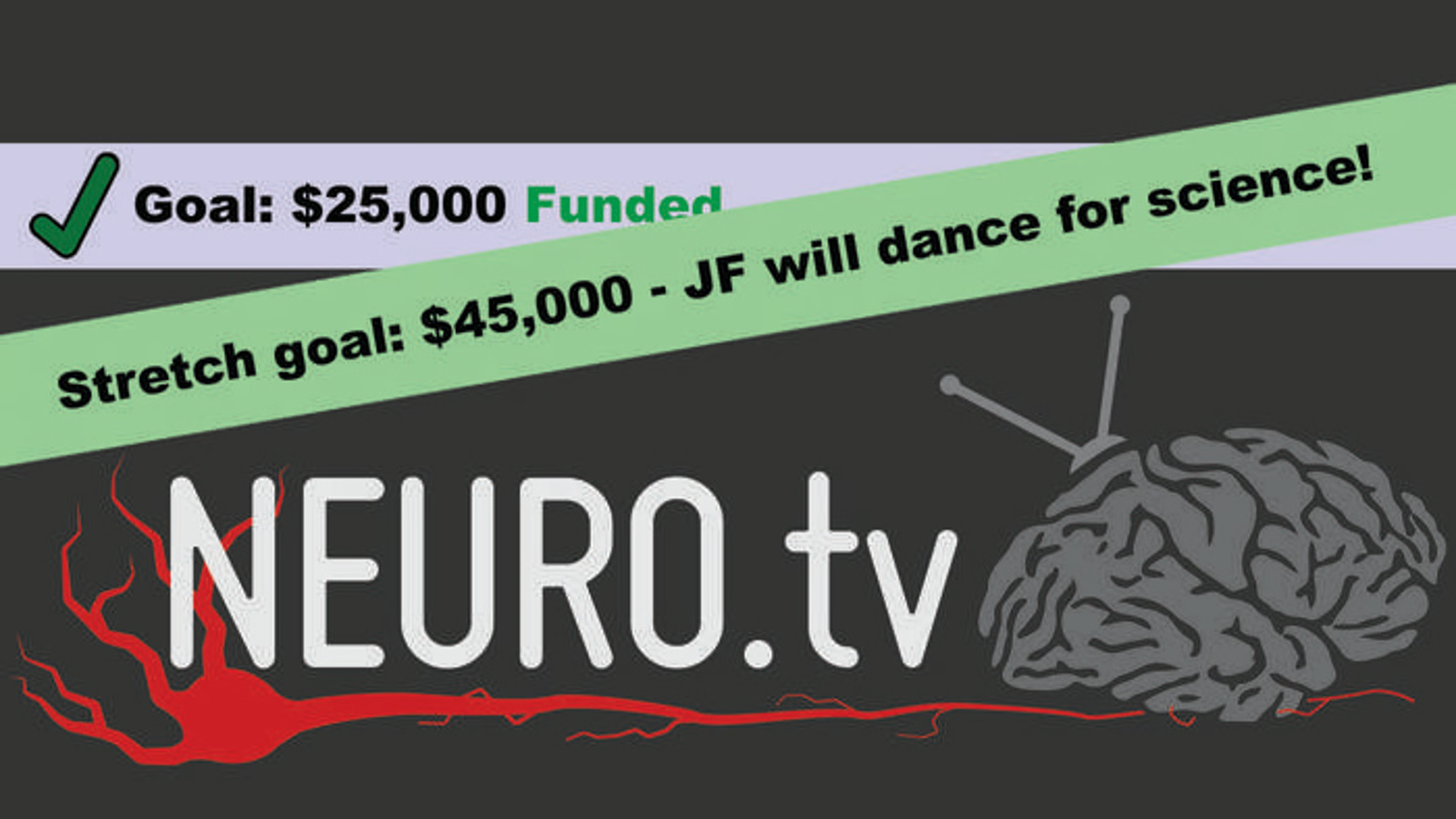
Guests in the first season included Antonello Bonci, then-scientific director of the National Institute on Drug Abuse; Dale Purves, a Duke professor emeritus of neurobiology; and Nita Farahany, a Duke professor of law and philosophy, archived NEURO.tv episodes show. (Gariépy said he removed the NEURO.tv episodes from his YouTube channel when he left Duke because he wanted to “make a clean split” into his personal YouTube career.)
By 2014, the journal Science named Gariépy one of the top 50 most-followed “science stars” on Twitter. Emails show he reached out to Epstein to fund the second season of NEURO.tv as well as a publishing company that would promote his forthcoming book. Epstein declined, Gariépy said.
Gariépy said he stopped producing NEURO.tv when he decided to pursue a career in political commentary. In a 2015 Facebook post announcing his departure from Duke, which Inside Higher Ed reported was shared 1,700 times within two days, Gariépy said he resigned in part because he’d grown disillusioned with the competitive nature of academia.
He lamented that “a large portion of the time of a scientist is spent on frivolous endeavors such as submitting a grant request to 5–10 agencies in the hope that one of them will accept.”
“I pushed the idea that the project would feature women in science. Knowing the circles were honing unto him, I thought it would appeal. He bit my bait.”
Jean-François Gariépy
The Daily Beast reported, however, that court filings in a child custody dispute between Gariépy and his third wife alleged Gariépy had a “sexually inappropriate relationship” with an undergraduate lab assistant and was not asked to return to his position at Duke. The student accused him of emotional abuse, according to The Daily Beast. Gariépy told The Assembly that the relationship was consensual; Duke told The Daily Beast it doesn’t comment on personnel matters.
Gariépy, whose academic research focused on how the brain generates social behaviors, has an unusual take on Epstein’s conduct.
“He was in fact a feminist, an adorer of women to the excessive point of his own destruction,” he wrote on X last year. “He dreamed of a world that would be dominated by women: scientists, CEO, etc. His sex acts were merely his awkward way to try to achieve his unrealistic utopia.”
Gariépy made similar comments in a recent livestream on YouTube. He praised Epstein for funding “out-of-the-box” scientific projects that “couldn’t possibly have received the support from mainstream institutions.” He questioned the veracity of accusations that Epstein sexually abused underage girls.
“What Jeff Epstein has been engaged in is absolutely morally condemnable and a corruption of our female youth,” Gariépy said. “But it is not pedophilia; it is sex trafficking.”
A DOJ and FBI review of Epstein investigative materials last year concluded “Epstein harmed over one thousand victims” and “each suffered unique trauma.”
The DOJ said the files “include a large volume of images of Epstein, images and videos of victims who are either minors or appear to be minors.”
Gariépy told The Assembly: “Epstein to me represents a man who came from another time and who dared to think boldly, and I believe he’s not being given enough credit for this. Maybe he violated the law. I don’t know for sure. Maybe he did. I don’t really care, though.”
Duke Connections
In his emails with Epstein, Gariépy said NEURO.tv was not associated with Duke, though he listed his affiliation with the university in his signature block and said NEURO.tv was “planned to become a Duke organization.” Gariépy told The Assembly it never did.
Still, the now-defunct website for Epstein’s foundation listed both NEURO.tv and Duke as beneficiaries of its philanthropy in 2013. In an email to The Assembly, a Duke spokesperson said, “We have searched our records and have been unable to find evidence of any financial contributions to Duke from Jeffrey Epstein.”
Epstein often exaggerated his foundation’s charitable work as he tried to sanitize his image, The New York Times reported. Recently released emails show how his reputation management consultants exploited the cachet of elite institutions to bury Google search results that referenced his crimes, including by issuing news releases that characterized Epstein as a prolific science funder.
“He dreamed of a world that would be dominated by women: scientists, CEO, etc. His sex acts were merely his awkward way to try to achieve his unrealistic utopia.”
Jean-François Gariépy
One such release, published in 2014, touted his support for NEURO.tv.
Epstein also sought to connect with David Rubenstein, the 1970 Duke grad, billionaire co-founder of the Carlyle Group, and then-Duke trustee. Rubenstein’s spokesperson said in an email that Rubenstein, now a trustee emeritus, “had one meeting [in 2012] for 20 minutes in Carlyle’s office, at the request of people seeking Mr. Rubenstein’s participation in philanthropic endeavors, none of which were pursued by Mr. Rubenstein.”
The documents also contain a 2012 email Epstein forwarded to his associate that included a photo of a woman in a bathing suit and a note that read, “for david rubenstein.” The Rubenstein spokesperson said he “never received the email with the photo and was unaware of it.”

As Gariépy was courting Epstein, Dan Ariely, a Duke business professor and behavioral researcher, was also in communication with the financier.
The emails between Ariely and Epstein span nearly a decade, starting in 2009. Duke’s student newspaper, The Chronicle, first reported Ariely’s ties to Epstein in late January.
The records suggest Epstein took interest in research on power and deception, including Ariely’s studies. Days after Ariely and billionaire Bill Gates were scheduled to meet with Epstein in 2012, Epstein wrote in an email to a redacted recipient: “had dan explaining to gates, irrationality of dating. fun.”
In an email to The Assembly, Ariely said, “The very few interactions I had with Epstein were strictly professional and connected to my academic work.”
“I am disheartened by efforts to link me to Epstein when the correspondence itself makes it clear that there is no evidence of anything inappropriate in our interactions,” Ariely added. “Most of all, however, I am heartbroken by the immense and untold suffering of the women he abused.”
“The very few interactions I had with Epstein were strictly professional and connected to my academic work.”
Dan Ariely, Duke business professor
Ariely’s research into dishonesty and irrational behavior helped him rise to prominence in the field of behavioral economics. He’s written several best-selling books, including Predictably Irrational. In 2024, Duke stripped him of his status as a James B. Duke professor, a prestigious title he had held since he joined Duke in 2008, after the university found he unknowingly used falsified data in a 2012 study on cheating.
The last exchange between Ariely and Epstein is from March 2019, four months before the financier was arrested on sex trafficking charges.
Epstein sent Ariely the link to a letter his lawyers wrote to The New York Times defending a secret 2008 agreement that allowed Epstein to avoid the potential of life in federal prison by pleading guilty to lesser sex crime charges. Ariely replied, “Sorry about this. How are you in general? I am mostly very good with some fun new adventures.”
Six months later, Ariely posted on X an article from the satire website The Onion, the headline of which read: “Harvard Officials Say $8.9 Million Donation From Jeffrey Epstein Was From Brief Recovery Period When He Wasn’t A Pedophile.”
You must be logged in to post a comment.