


Before he arrived in Charlotte for the United Methodist Church’s General Conference, Caleb Parker was trying to keep his emotions in check. As a delegate to the top legislative body for the 10 million-member church, Parker knew that his equality as a gay man would be up for debate over the next 11 days.
Parker, 41, grew up in a 200-year-old Methodist congregation outside Elizabeth City and came out after he left for East Carolina University. That’s when he started to reckon with a church that since 1972 had called homosexuality “incompatible with Christian teaching.”
The United Methodist Church (UMC), for decades, has been boiling over this language, and over its bans on same-sex marriage and on the ordination of non-celibate lesbian and gay clergy. The conflict has sparked protests, arrests, investigations, and church trials. It’s also, for Parker, made for some frustrating experiences.
As a young adult, Parker attended his region’s annual conferences as a member of the Reconciling United Methodists and Friends of North Carolina, an LGBTQ-affirming caucus. “We would always have a booth, and they would always put us beside the most homophobic person with a booth,” he said. “And like, ‘Look, people can walk by and get both sides.’ Because they’re equal, right? One believes queer people aren’t real people, and the other believes that they are.”
Parker has seen the church evolve slowly since then. In February 2020, just before the pandemic, 10 UMC ministers (plus two other clergy) jointly officiated his wedding in Durham. Duke Memorial United Methodist Church, where the ceremony took place, called it an act of “holy disobedience.” The region’s bishop received a formal complaint, but the pastors were never publicly disciplined.
This evolution toward full LGBTQ participation has ruptured what was historically the United States’ largest mainline Protestant denomination. One-fourth of all congregations nationwide have left the UMC since 2019, primarily out of concern that the church was becoming too permissive. In North Carolina, 36 percent have left. Meanwhile, the UMC is expanding overseas, including in some places with hard-line views on sexuality and marriage.

The General Conference that Parker was set to attend April 23 through May 3 would be the United Methodists’ first opportunity since the split to reconsider their views on sexuality, while also trying to hold together a diverse international network of believers.
In anticipation of this meeting—originally scheduled for 2020 but postponed four years because of the pandemic—Parker had teamed up with another North Carolinian, 58-year-old Helen Ryde, to found the Queer Delegate Caucus. They had ambitious legislative goals, but Parker wasn’t expecting a revolution in Charlotte. Just a boot off his neck, he said.
“My hope ultimately is that queer people would be affirmed, empowered, and protected, and that’s not going to happen,” he told me before the conference started. “I’m conceding that my work, my dream, will not be achieved at this General Conference. What I’m looking at is the long process.”
A Half-Century of Debate
The United Methodist Church has a global reach, but it’s also been a mirror of America’s political tensions. Its struggles with slavery, Vietnam, desegregation, and abortion have paralleled the nation’s own. Now, as state- and federal-government efforts to roll back LGBTQ rights intensify, it seemed unavoidable that sexuality would again dominate the General Conference.
It’s been 52 years since the UMC first declared homosexuality and Christianity incompatible. The language came amid a moral panic depicting gay men as predators. “I have a 12-year-old boy and I have problems,” one delegate said during that 1972 debate. “I’m worried what I would do if a homosexual violated my young son.”
Over time, traditionalists came to argue that their objections to LGBTQ equality weren’t about sexuality so much as scriptural authority. “When I find that something is being taught that’s absolutely contrary to Scripture, it grieves me,” the Rev. Chris Fitzgerald, then-pastor at Wesley Memorial United Methodist Church in Statesville, told me when I wrote about his congregation in August 2022. (He retired the following November, two weeks after his flock voted to stay in the UMC.)

For moderates and progressives, the church’s stance sent an un-Christlike message that some lives have more value than others.
The UMC last tried to settle this dispute during a special off-year General Conference in 2019. Its Council of Bishops, a group of senior clergy, had endorsed a plan giving individual ministers the authority to decide whether to marry same-sex couples. Ordination would have become a local decision, too.
The 2019 delegates rejected the bishops’ suggestion. Instead, U.S. conservatives teamed up with some international delegates to double down. Under their “Traditional Plan,” which passed, ministers could be suspended without pay after performing a first same-sex wedding, and defrocked after a second.
The delegates also passed a temporary mechanism for any congregation that wanted to leave the UMC “for reasons of conscience … related to the practice of homosexuality.” If members agreed by a 2-1 majority, and the church paid an exit fee to cover obligations like clergy pensions, it could disaffiliate—and, crucially, keep its property—until the end of 2023.
The new marriage rule sparked an American blowback. North Carolina is divided into eastern and western regions, with a total of 36 delegates (out of 862 worldwide). Both regions elected delegate slates for 2020 that overwhelmingly supported LGBTQ inclusion.

“The immediate, visceral response for people was ‘This Traditional Plan does not represent us, and so we need to do something to fix it,’” said Ryde, the Queer Delegate Caucus co-founder, who lives in Lake Junaluska and works as an organizer for the Reconciling Ministries Network. “It was probably one of the least effort-required organizing work that I’ve ever done, because everyone wanted to do something.”
Conservatives saw the tide shifting. Yes, their plan had won the day, but they were also losing influence. Many took advantage of the chance to disaffiliate and keep their buildings. The UMC’s two North Carolina regions, combined, lost 671 of 1,839 churches by the end of 2023.
The Children of Divorce
On the first day of this year’s General Conference, the Rev. In-Yong Lee, pastor of First United Methodist Church of Rutherfordton, walked onto the delegate floor, took her assigned seat, and prepared for the opening worship. There was a gospel choir and a brass band, followed by a sermon from Bishop Thomas Bickerton that set the tone for the next two weeks.
Bickerton, the outgoing president of the Council of Bishops, called for a hard reset. “We have drawn a line in the sand for 52 years now about how we include or exclude others,” he preached. “But friends, the water of life has eroded the line. We have a wonderful opportunity to live a sacramental theology that says, even though we do not agree all the time, everyone is welcome at our table.”
He pushed back against the traditionalist argument that Methodists who support LGBTQ inclusion don’t believe in Scripture and decried the “vendettas and last-gasp jabs” that marked the last few years. The UMC was moving on, he said. “If you are not committed to that,” the bishop added, “we might just ask you, with integrity, that you just leave us alone to do our work.”
Lee felt her neck and shoulders relax. She looked around the room and saw smiles.

Lee, a 61-year-old immigrant from South Korea, sits on a committee that helped develop a fundamental restructuring of the UMC. “Worldwide regionalization” would give the UMC’s overseas regions equal standing with the United States. Countries like the Philippines, Côte d’Ivoire, and the Democratic Republic of the Congo would no longer be considered mission fields but rather partners in shaping the future.
This, to her, was a necessary corrective. “Americans have developed this arrogance,” Lee said. Putting other countries on equal footing, she said, would help “decolonize” the church.
It would also allow the U.S. region, for the first time, to adapt certain church policies to fit its own cultural norms. (Regions in Africa, the Philippines, and Europe already can.) American Methodists in a regionalized UMC could more freely embrace sexual diversity, even if some of their counterparts abroad didn’t.
Lee had met with the committee working on regionalization before the conference, and it was “of one mind, mostly,” she told me. Between their cordial conversations and the bishop’s sermon, she was feeling optimistic.
But delegate Emma Austin was feeling “very, very nervous.” The 20-year-old was finishing a semester at UNC-Greensboro, where she majors in theater education. She had grown up in the faith: Her father pastors a church in Boone, and she attended her first regional conference before she started walking. The feud over sexuality has divided the UMC for her entire life.
Austin didn’t know what to expect in Charlotte. “I was a little worried that it was either going to be fighting tooth and nail every second of every minute,” she recalled, “or ‘Let’s just sweep this under the rug and we’re all friends and let’s not talk about it.’”
On the second day, Austin listened to the Young People’s Address, delivered by Alejandra Salemi, a Duke Ph.D. student who studies how religion influences health beliefs and behaviors. Salemi compared the UMC’s schism to a divorce, and its young members to the children of a broken marriage.

“They said, ‘Don’t worry, children, this is what’s best,’” Salemi told the delegates. “All while they ripped up our home brick by brick and continued throwing daggers at each other, parent to parent.”
This resonated with Austin. She worried that her generation was tasked with mopping up a spill that they hadn’t caused. Older delegates and observers often told her they were excited to see someone her age participating. That was gratifying, in a sense. “But I also have had to remind some people that, while we are the future … we can’t move forward if we spend a lot of time fixing the things that were broken before we got there,” she said.
‘Something Very, Very Different’
By the end of the first week, it was clear to everyone that the rancor of past conferences was absent in Charlotte. With 25 percent of the U.S. churches gone, a pressure valve had opened. Many traditionalists remained, but there had been an exodus of congregations that couldn’t abide by a big-tent denomination.
“We are all experiencing something very, very different from previous General Conferences,” Lee said. “More harmonized.”
On April 25, the delegates passed a constitutional amendment, with 78 percent of the vote, that would move the church closer to regionalization. The amendment still needs to be ratified by regional groups of clergy and lay members, but Lee said she felt “cautiously hopeful.”

Most of the first week was taken up by legislative committee work. One committee Parker sits on recommended approval of the UMC’s Revised Social Principles—a statement of Methodist values that doesn’t carry the force of church law—eliminating the 1972 language calling homosexuality and Christianity incompatible. The revised document also redefined marriage as a covenant between “two people of faith” rather than a man and a woman. After a short debate, it passed with 75 percent of the vote.
“Have you ever gone to pick up a box you thought was really heavy, but it was super light and then end up flinging the box over your head because you used undue amounts of energy? Yeah. That’s where I am,” Parker wrote on Facebook that evening. “I thought the work would be far heavier emotionally and spiritually.” But then, he wrote, “20 minutes and done.”
I caught up with Parker at the end of the first week. He was driving, with Ryde, to a Queer Delegate Caucus meeting and still managing his expectations. “Trying not to get ahead of myself,” he said.

Ryde, who uses nonbinary pronouns, noted that committee approval was just the first step. All the LGBTQ legislation—including ordination, marriage, and the incompatibility language—still needed to come before the full conference. And some of it could prove contentious.
“It’s almost certain that we will hear more harmful language this week than we did last week,” they said. “There’s more likely to be people coming up to the microphone in the big space and potentially saying some stuff that is not good. But we’re prepared for that.”
Gone in a Whisper
The first monumental LGBTQ policy change came in a whisper that Wednesday. Delegates were asked to vote on a “consent calendar,” a bundle of uncontested—and typically noncontroversial—items that are enacted together for legislative expediency. The polling opened and closed. The vote was 692 to 51.
The 30-year ban on lesbian and gay clergy: gone, just like that.
“Can we please hold our excitement?” the presiding officer asked. The celebratory roar subsided and the meeting proceeded.
To Parker, the vote felt anticlimactic. “I was prepared for a floor debate,” he said. “I was prepared for the world to be watching this one conversation and this one vote about the dignity and life of queer people. … I came in with all this energy, and ready, and then it’s just, ‘We’re done. Next.’”
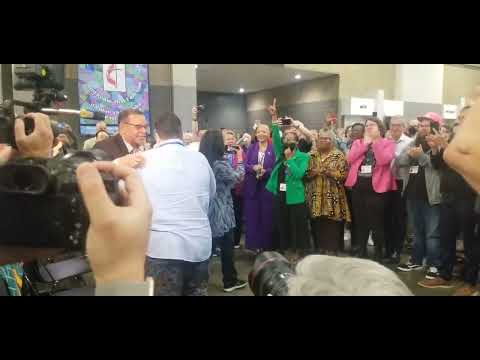
Still, he recognized how significant the vote was. During midmorning recess, he and Ryde met at a spontaneous circle that was forming at the edge of the floor. Friends embraced. Arms rose in prayer. Photographers pressed against the security barricade as delegate Jorge Lockward led his colleagues in song:
Draw the circle wide, draw it wider still.
Let this be our song: no one stands alone.
Lockward spotted Ryde half-hiding in the crowd. He reached for their hand and led them to the foreground. The singing morphed into cheers. Ryde stood in silence, shaking their head, uncomfortable receiving so much individual attention for such a collective effort.
Ryde’s journey to this moment was circuitous. After a born-again experience at 18, they began attending evangelical churches in England and underwent ex-gay conversion therapy. It wasn’t until after they emigrated in 1998, at age 32, that they came out, and later reconnected to their faith at a Methodist congregation in Provincetown, Massachusetts. (At its bake sales, Ryde said, “the gay guys were always the much better bakers.”) Ryde eventually quit their job as a bank vice president to work for the Reconciling Ministries Network.
“This is a day of rejoicing. But, my God, this is a day of lament,” Ryde told the circle. “There are so many who weren’t here for this moment because they had to go somewhere else to care for themselves. … I am so grateful right now. But I can’t rejoice without naming that.”
Parker stood beside Ryde and, for the first time during the conference, he let himself cry happy tears. “This is a space of trauma and pain,” he later told me. “This moment was the first time I could let that go.”
Momentum
As the conference neared the end of its second week, Austin found herself envisioning what the future of the UMC might look like. The ban on lesbian and gay ministers was gone. The delegates were chipping away at the same-sex marriage ban. The church was about to apologize to victims of sexual misconduct and had already apologized for its role in the 1893 overthrow of the Hawaiian monarchy.
She could see a denomination that repairs the damage it has caused, that has more diverse leadership, that ministers to the people struggling the most. “I want to keep that momentum going,” she said.
She was also aware that welcoming some people might drive away others. “Because we have opened our doors even wider than they were before, that doesn’t mean that we can just close out the people who don’t agree with us,” she said. “Going forward, I want to continue to allow different people and different walks of life and different cultures into the church to inform our practices. … I think that’s the only way that the church doesn’t, for lack of better words, die.”
It looks like Austin will have a say. On May 2, she was elected as the young-adult representative to the committee planning the 2032 conference.

The biggest test of unity came that same day, when the full General Conference finally discussed whether to approve its Revised Social Principles—removing the language calling homosexuality incompatible with Christianity, and also striking gender from the definition of marriage.
In the 75 minutes of floor debate, incompatibility was never mentioned. But the redefinition of marriage, for some, was a step too far. “To those who use the pronouns they, their, and theirs,” said delegate Nimia Peralta of the Philippines, “I mean no harm. I love you with the love of the Lord. But please understand where I am coming from, literally.” Her country recognizes marriage only between a man and a woman; this, she said, was God’s design.
For all the talk of regionalization, Peralta added, “I firmly believe that God’s word can never be regionalized.”
Supporters called the principles broad enough for different interpretations in different regions. “In the region where I work,” said the Rev. James Howell, senior pastor at Myers Park United Methodist Church in Charlotte, “cynics and young adults will not listen to us talk about Jesus if we say that we do not condone people that they love and care about.”
Then a delegate from Zimbabwe offered a compromise. What if the definition of marriage were explicitly “double-barreled,” saying either a man and a woman or two adults, asked Molly Hlekani Mwayera, who is also a Supreme Court judge in her home country. That would reflect the spirit of regionalization, she said.
Delegates sensed a breakthrough: opening the door for same-sex marriage where it’s legal, while also holding together the worldwide church. “What Mwayera offered was just beautiful,” said Parker. “It’s what we needed: an African colleague offering both ideas that were not in conflict.”


Parker voted yes on the amendment. “If I could’ve voted for it 10 more times, I would have,” he said. So did Austin and Ryde. Lee voted no, because she didn’t want the man-woman language to return, but later said she came to understand the rationale.
The amendment passed with 72 percent of the vote, despite a couple more protests.
Then the delegates voted, by a 76-24 margin, to adopt the Revised Social Principles.
At the recess, both supporters and opponents of the changes rallied outdoors. The supporters were jubilant. The opponents were defiant. “We will never accept marriage as anything other than one man and one woman,” the Rev. Jerry Kulah, a delegate from Liberia, said at the traditionalist rally, according to Religion News Service. “We are devastated now to be part of a denomination that officially contradicts the Bible’s teaching on marriage and sexual morality.”
I walked back inside with Parker. He was buoyed by the victory and said he didn’t feel discouraged by what the other side was saying.
“We needed to be reminded of where we have been for decades,” he said. Some moderate Methodists won’t take sides unless the rhetoric is so harsh, and the policies so draconian, that they have no choice, he said. “The centrists needed [to hear] that voice, and they needed to be able to say, ‘I can’t vote for that. I’m going to have to vote for something else.’”
Barry Yeoman is a freelance journalist based in Durham. Find more of his work here.
You must be logged in to post a comment.