


Note: This article mentions suicide. If you or someone you know is having suicidal thoughts, call the Suicide & Crisis Lifeline at 9-8-8.
The Rev. Chris Fitzgerald walked out of Wesley Memorial United Methodist Church in Statesville on May 1 feeling like he was about to explode.
He drove home, poured himself a glass of tea, and tried to calm himself with deep breathing. Then he reached for the blood-pressure monitor that he keeps on a nearby table.
Chris, this is stroke territory, the 65-year-old pastor said to himself as the black numbers flashed against a gray background. He thought about his plans for retirement: hunting deer, fishing for flounder, traveling to disaster zones in a tiny camper to volunteer his labor. A debilitating stroke, he feared, could take all that off the table.
Fitzgerald knew the reason his blood pressure had spiked: a meeting that afternoon in the church fellowship hall that exposed his congregation’s long-standing but unspoken divisions. What began as a one-way “information session” had turned into a jagged debate over the issue that has consumed Methodists everywhere.
For decades, the United Methodist Church (UMC), America’s largest mainline Protestant denomination, has taken a hard line against same-sex marriage and the ordination of non-celibate lesbians and gay men. The UMC reaffirmed and even toughened that stance in 2019. But a sizable number of clergy and laypeople rejected the position as harmful and un-Christlike, and the long-running dispute has triggered church trials, civil disobedience, and mass arrests. Each side has accused the other of dishonesty and political maneuvering—a cycle of mutual recrimination.
As the rancor dragged on, it became evident that one side needed to leave. A group of traditionalists made the break this spring, launching a new denomination called the Global Methodist Church.
Congregations like Fitzgerald’s now need to pick a side. Or they can choose not to decide, and remain in the UMC by default. For theologically homogenous churches, the direction might be clear. But Wesley Memorial’s 400 members span the gamut, the minister said, “from almost flaming progressive to dang near fundamentalist.”
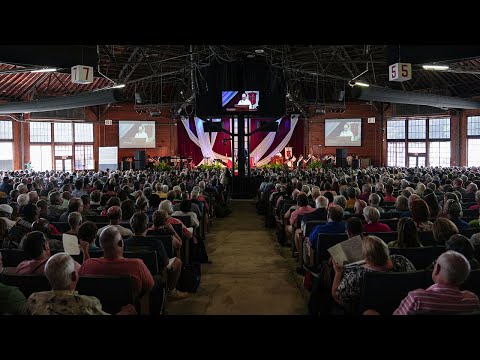
They are, in other words, a cross-section of Methodists, bracing for a high-stakes conversation that they managed to avoid until 2022. “I’ve got those who are adamant about, ‘I don’t want to be a part of an apostate church, and right now I feel like I am,’” Fitzgerald said. “And I’ve got those that are just as determined, saying, ‘I will not be a part of a traditional orthodox congregation. And if we do not stay United Methodist, then I will be leaving.’”
He wondered that Sunday, as he wonders often, how long his flock will continue to worship in the same building—how long the “United” in their name will hold.
America’s Church
The Methodist movement is sometimes called “America’s church” because of how closely it mirrors the fault lines and contradictions that permeate our culture.
Its moral trajectory has been a zigzag. It cleaved over slavery; opposed sweatshops and child labor; sparred over desegregation (the U.S. Church is 94 percent white); and condemned America’s involvement in Vietnam as a “crime against humanity” while supporting both resisters and enlistees. It has steadfastly opposed the death penalty and maintained a “reluctant” support for abortion rights, peppered with caveats.
“Sometimes it’s prophetic,” said the Rev. Amelia Stinson-Wesley, pastor at Memorial United Methodist Church in Charlotte. “And sometimes it’s just 40 years too late.”
No modern issue has roiled the Church so much as homosexuality, which Methodists started debating at their 1972 legislative session, the General Conference. That year, a committee floated a measure affirming the “sacred worth” of gays and lesbians and advocating for their civil rights. Some delegates, responding to popular stereotypes, reacted with outrage. “If this in any way gives them a license to continue in their activities of preying upon the young men of our community,” said one, “I want it eliminated.”
The conference did pass the measure, but only after adding a statement calling homosexuality “incompatible with Christian teaching.” That language remains in effect today.

The debate kept resurfacing—every four years at the General Conference, and in local skirmishes too. One of the earliest played out in North Carolina, home to 1 out of every 13 U.S. United Methodists—the nation’s second-largest population after Texas.
In 1988, the Rev. Jimmy Creech, who is straight, marched in Raleigh’s Pride Parade, and the ensuing conflict cost him the pulpit at Fairmont United Methodist Church. Creech moved to Nebraska, underwent two church trials, and was defrocked in 1999 for co-officiating a same-sex holy-union ceremony in Chapel Hill.
Over time, attitudes changed. In 2007, a Pew Research Center survey showed that 51 percent of U.S. Methodists believed homosexuality should be accepted. That figure rose to 60 percent by 2014. Two years later, when the Rev. Valerie Rosenquist married two men at Charlotte’s First United Methodist Church, she survived a battery of complaints without losing her pulpit or her credentials.
But with the rising belligerence of American politics, the battle has only escalated.
“As our country became more divided, us-and-them politically, outside of the Church, that creeps into the Church,” says the Rev. Lory Beth Huffman, a district superintendent in the UMC’s Western North Carolina Conference and an advocate for more inclusion. “Instead of being able to have honest conversations—to wrestle with, ‘What is God saying here? What is Scripture saying here?’ in our Methodist way, ‘What is our experience telling us here?’—it became, ‘Oh, you’re either a Bible-believing Scripture follower or you’re not. You are of the culture and you are not being faithful.’”
There was talk of the Church splitting, but that wasn’t so easy. Each congregation owns its property in trust for the larger denomination. If a congregation leaves, it risks forfeiting its building and other assets.
At the 2016 General Conference, delegates introduced more than 100 resolutions related to human sexuality. Rather than take them up, the denomination asked a task force to review all sexuality-related church law. That was supposed to produce a practical solution. Instead, it accelerated the conflict.
Meanwhile, Chris Fitzgerald was settling into his new job at Wesley Memorial.
All Flavors of Belief
Fitzgerald knew where he stood on LGBTQ issues. A self-described “dinosaur of a preacher,” he’s the 15th Methodist minister in his family—“a genetic defect,” he calls it—and has been preaching for 43 years.
“It’s not just a job,” he told me. “My sister said, years ago, ‘You have a mistress,’ and I said, ‘I do not.’ She said, ‘Yes, you do. It’s your church.’” He paused, then added, “Guilty.”
He arrived in Statesville in 2015 from First United Methodist Church in High Point, where a lesbian couple had asked him to baptize their twins. “Incredibly nice, loving people,” he said of the women. “Both in the health care profession. Both the kind of person that you would really want taking care of you.” But he also believed heterosexual marriage was essential to God’s plan, and flouting that plan was a sin.

“Regardless of what you may want to believe, ‘male and female He created them,’” he said, quoting from the book of Genesis. “And that was for a reason. That’s part of the created order, and Jesus upheld that.”
Fitzgerald agonized for weeks, and talked with colleagues, before declining the request. “It’s not about the babies,” he said. “Those babies are as innocent as can be.” Nor was it based on a conviction that the mothers were going to hell. “Oh, gosh, that’s way beyond my pay grade,” he said. “I am not the one who makes that call.” But the baptism ceremony would have required the women to vow to repent their sins, and he knew they weren’t about to forswear their intimate relationship. (After he left High Point, he said, his cousin took over the job and immediately baptized the children.)
The pastor knew the irony: He is divorced, and that too is a sin in his faith. In fact, he noted, Jesus said nothing about same-sex marriage, but plenty about divorce.
“Then how do you dare do that, Chris?” he asked. “You throw yourself on the altar and say, ‘Lord, I never intended to go through this. But I did. And having gone through it, I’ll try and live the rest of my life single and celibate.’” Self-denial, he said, can be grueling: “When I see certain women, I go, ‘My lands! She is fearfully and wonderfully made.’ And if I’m not careful, my mind will go to all sorts of places. And I have to reel that in.”
When he was reassigned to Statesville, Fitzgerald understood he’d be leading a congregation with “all flavors” of belief. One of 41 United Methodist churches in Iredell County—which flanks I-77 from the Charlotte exurbs north to the edge of Appalachia—Wesley Memorial runs two distinct Sunday services. There’s contemporary worship in the fellowship hall, with electric guitars and T-shirts and cardboard cups of Starbucks; that’s followed by a more formal service in the A-frame sanctuary, with robes and sashes and chimes.

During the break, adult Sunday school classes teach competing theologies. When I attended one class, it was reading Robin R. Meyers’ Saving Jesus from the Church, which advocates a faith that uplifts compassionate action over condemnatory words. Members of that class were pooling funds to give to an LGBTQ support group.
Members arrive each Sunday with different life experiences—all those losses and traumas—that in turn have produced different values, different interpretations of Scripture, and different understandings of how knowable God’s intentions are.
“The issue was settled before I was alive,” said Seth Dufault, a 36-year-old who works in wastewater maintenance and who considers homosexuality a sin. “We don’t have to have this back-and-forth. God settled it … I’m just here to do his bidding.”
“You could put on a head of a pin, probably, what the whole human race knows about God, in relation to what God is,” said Sara Thompson, a retired high-school English teacher who favors more inclusiveness. “In my heart, nothing trumps human kindness.”

Shortly after his arrival, Fitzgerald said, he told the leadership team that Wesley Memorial would need to reckon with the larger Church debate over homosexuality. But he was reluctant to push the issue before he needed to.
“There’s enough chicken in me that wants to avoid conflict, wants to avoid seeing a congregation split, that the most tempting thing is just to push it all under the rug,” he said. “Well, it’s not going away. It’s really not.”
‘It Was Going to be Chaos’
The task force that came out of the 2016 General Conference developed three separate proposals. The front-runner had the support of the UMC’s Council of Bishops, a body of senior clergy who oversee different geographic regions. It was called the One Church Plan, and it envisioned a diverse denomination in which individuals could act out of their own consciences.
Ministers could choose to marry same-sex couples, but no one would be forced to. Local bodies could develop their own ordination standards. And for the first time since 1972, the language of incompatibility would disappear.
The UMC called a special off-year General Conference in 2019. To the surprise of many, the One Church Plan lost. U.S. conservatives teamed up with the growing international delegations—particularly from Africa, where the Church is having a heyday—to kill the big-tent legislation. Instead, they passed something called the Traditional Plan, which kept the restrictions in place and toughened enforcement. A minister officiating at a same-sex wedding would now be suspended without pay for a year. After a second wedding, they would be stripped of their credentials.
The decision sparked protests, bribery allegations, and questions of voting irregularities. Some advocates of inclusion felt blindsided. “It was a targeted, well-planned, well-executed flashback that many of us did not expect,” said the Rev. Mary John Dye, interim pastor at Triplett United Methodist Church in Mooresville. “It was a takeover. It was a planned takeover.”
Even some conservatives were caught off-guard. “I was shocked, but I was also relieved and happy,” said the Rev. Angela Pleasants, a former UMC minister in Charlotte who now works for the breakaway Global Methodist Church. “But then there was also a part of me that said, ‘Oh, boy, this is not going to be good, because now it’s going to be amped up even more, this hostility back and forth.’ And sure enough, it did happen.”
Four months later, Methodists from Western North Carolina, including Iredell County, gathered at their mountain retreat center at Lake Junaluska for the region’s annual conference. Advocates of inclusion were in the majority, and they passed a statement of dissent by a 63-37 margin. “We commit to resist evil, injustice and oppression in all forms,” it said. “We reject the Traditional Plan approved at General Conference 2019 as inconsistent with the gospel of Jesus Christ and will resist its implementation.”

Then the Western North Carolinians elected their delegates to the 2020 General Conference—a near-sweep of pro-inclusion candidates. “Everybody who was elected is not a wide-eyed liberal,” said Dye, the Mooresville pastor. “Not by a longshot. But conservatives were not going to be elected. They were no longer trusted.”
Fitzgerald was at Lake Junaluska and felt the lack of trust. “Never have I been at an annual conference … where there was so much enmity, meanness, strife, backbiting, accusatory events from the top down,” he said. “It was such a clear display of progressive agenda, almost to the point of, ‘Why don’t you other people just die and get out of the way?’”
On the drive home, he said, he cried all the way down Old Fort Mountain.
Western North Carolina wasn’t an outlier. Regional bodies across the United States rejected the Traditional Plan. “That sent a huge signal to the denomination that we’re getting ready to break,” said Huffman, the district superintendent, who had co-sponsored the Lake Junaluska resolution. “People are not going to uphold the Traditional Plan. Bishops, boards of ordained ministries—they were not going to abide by that. Which meant church trials were going to abound. Which meant it was going to be chaos.”
With a split inevitable, the UMC brought all sides to the negotiating table. Kenneth Feinberg, the attorney who helped broker the September 11 and BP oil-spill compensation funds, served as a neutral mediator. (He is Jewish.) Together, they hammered out a separation plan called the Protocol of Reconciliation and Grace through Separation. The UMC agreed to donate $25 million to launch a new, traditionalist Methodist denomination. Congregations could vote to leave the UMC and keep their property if they joined another Methodist group. Before taking effect, the plan needed to be ratified by the 2020 General Conference.
“And then COVID just wrecked it all,” said Huffman.
The General Conference got postponed to 2021. And then again to 2022. And then to 2024. The Protocol never got ratified. Traditionalists grew impatient. This May, they launched the Global Methodist Church without waiting for the formalized agreement (or the $25 million). “We’ve already seen that there’s not going to be a way that we can do this together in an amicable way,” said the Global Methodists’ Pleasants.
Under temporary rules, a church that cannot abide by the UMC’s direction on homosexuality may disaffiliate and keep its property. It needs to pay an exit fee, ranging from tens of thousands to more than a million dollars, to cover obligations like unfunded clergy pensions.
At Wesley Memorial, the two sides were about to have the conversation they had long deferred.
‘You Surrender Yourself’
Fitzgerald, anticipating the schism, finally wrote a sermon earlier this year about homosexuality. He showed it to some people he trusted. “I had a music staff person say, ‘If you do this, you’re going to tear the music program apart. I’m going to lose some of my main singers,’” he said.
He decided to shelve it, at least for the time being.
He did call a pair of meetings, with different speakers, to discuss the tensions within the denomination. The first would take place after services May 1, the same day the Global Methodist Church launched.
That morning, Sara Thompson, the retired teacher, attended the formal service, as she has for 50 years. Her views of LGBTQ people had been shaped by a series of personal encounters—“like lampposts lighting me to my decision,” she said. There was the high-school friend who always took her out on their shared birthday, and who she later learned died of AIDS. The gay student who got taunted by two other boys inside her classroom until he finally shouted, “Leave me alone!” The hairdresser who waited for years for the right to marry his husband, only to be widowed shortly afterward.
“Marriage is church,” said Thompson. She and her husband had married at Wesley Memorial, “not because I thought it would be less legal if I went to the courthouse, but because it meant something spiritual to me to commit to somebody. Why should anybody not have that if that’s what they want?”
At the same service, Rebecca Hitch put on a red robe and sang in the choir, as she did back when her husband was the pastor. She was thinking that day about her gay nephew, whose kindness, she said, was evident since childhood. When her mother had dementia, he would sit with her and answer the same questions over and over, never losing patience.

The nephew was raised United Methodist, and she believes that, as a young adult, he could have used the love of a congregation. “With a policy like the Methodist Church has now, how can you feel that they love you?” said the retired school human-resources professional. “It’s got to impact your faith.”
Seth Dufault, the maintenance worker, attended the contemporary service that day. As a teenager, Dufault drifted from the church that had looked down on his family after his parents’ divorce. Then he, too, suffered a nephew’s death, which shook up his priorities. He returned to faith in his 20s, he said, and worked on humbling himself before God.
This was, and remains, hard for someone who considers himself an “alpha male,” but he said he recommits every day. “When you become a Christian … you surrender yourself,” he said. “What you feel morally is right and wrong has to be adjusted with what God tells you is right and wrong.”
Dufault read the Bible cover-to-cover. As he worked to discern its meaning, he arrived at the Sermon on the Mount, in which Jesus said, “One jot or one tittle shall in no wise pass from the law.” This, to him, acknowledged the continued relevance of Old Testament law, including the prohibition on homosexual acts. “Now, I don’t think they need to be put to death,” he told me. (In fact, he supports civil marriage for his gay friends, following Jesus’ directive to “render to Caesar the things that are Caesar’s.”) “But at what point am I a servant of God? Or do I assume that I know better than God?”
From across the theological divide, about 100 people arrived at the fellowship hall on that day in May. They sat at round white banquet tables and waited to hear a stranger make the case for leaving their denomination.
Lest You Be Judged
That stranger was the Rev. Cliff Wall, pastor at Clarksbury United Methodist Church in rural Harmony, near Statesville. A firebrand at the lectern, Wall has criticized his colleagues for “dithering” over sexual morality—even as, in his view, a defiant U.S. clergy and leadership have undercut the UMC’s strict rules.
“We have to be honest about where we are,” he told the members of Wesley Memorial. “The United Methodist Church is becoming more and more ungovernable. … You are actually now being asked to celebrate and accept the LGBTQIA+ spectrum, which does include drag queen, cross-dressing ministries in the local churches. And if you haven’t caught on yet, this is a total abandonment of the teaching of Jesus.”

The parishioners were directed to listen quietly and write their questions on notecards. Mostly, they did. But an hour in, Sara Thompson felt herself getting physically agitated.
“You are sensationalizing,” she said. “Jesus never spoke on homosexuality. He never spoke on it.”
“He did speak indirectly about it,” Wall said.
“Not indirectly,” Thompson replied. “He never spoke on it. And it was well known in his time.”
With the silence lifted, Rebecca Hitch chimed in. “I’m divorced, OK? According to the Ten Commandments, plus what Jesus said about marriage, I’m an adulteress.” Even so, she continued, “I can still pastor a church in the United Methodist Church. True or false?”
“Yes, that is true,” Wall said. “In the Global Methodist Church”—the new denomination—“if there’s repentance and contrition, we’re not going to teach that it’s the unforgivable sin.”
Then why exclude gay men and lesbians? “He never said anything specifically about homosexuality that I’ve ever read,” Hitch said. “True or false?”
“There’s a lot of things that Jesus never explicitly speaks about,” Wall said.
Hitch asked for one last statement. “I don’t want to get emotional here,” she said, her voice cracking. “My sister’s older son, three years ago at the age of 27, shot himself. He was gay.” (He didn’t leave an explanation for the suicide.) “So yes, I am biased in this area, as far as what I believe about homosexuality and whether or not it’s a choice, and whether or not you can go through some kind of conversion therapy and be cured of it. I don’t believe any of that, and so you can call me biased. I am laying it on the table here. But—”
“I understand,” Wall said.
“—I don’t think that I am less of a Christian person because I believe like I believe.”
A minute later, Wall asked the audience to imagine a polyamorous couple applying for membership. “What do you tell the couple when they say they want to join the church, but they’re not willing to give up that lifestyle?” he asked. “And, in fact, they think it’s such a great lifestyle that they want to start a swingers’ club at the church?”
“Has that ever happened in your career?” Thompson asked.
“Not in my career,” Wall said. “But—”
“I cannot imagine it happening,” Thompson said.
“It is happening,” Wall insisted.
“We do not screen people that come to church here,” said another member. “We’re not going to kick them out because we don’t like their lifestyle. That’s not for us to judge.”
“I’m sorry,” Wall said. “But was she saying that we would allow just anybody with any behavior?”
“You’re judging,” Thompson said. “You’re judging people, when literally the Bible says, ‘Judge not, lest you be judged.’”
“Hold on, hold on,” said Seth Dufault. “What does the rest of the Scripture say?” That chapter from Matthew, as he understands it, teaches how to judge, not not to judge: to take the plank from your own eye before removing the speck from your brother’s.
Two weeks later, when the UMC’s Huffman came to offer a counterpoint, Dufault stayed home. Upset as he was by how argumentative the other side had become, he was concerned that, with the roles reversed, he might do the same.
A Name With Feelings
Some Methodist churches are ticking along without having this wrenching conversation. I attended one of them in mid-June: Monticello United Methodist Church, just outside Statesville city limits. Joining me was one of its members, a 56-year-old lesbian named Donna England.
England is an Army veteran who runs a business cleaning and beautifying graves. Her volunteer résumé is exhaustive: a literacy camp, a homelessness ministry, a reentry program for former inmates, non-contact boxing classes for people with Parkinson’s disease. She lives on a cul-de-sac with her partner of 23 years, Sherry Morgan, and two elderly dogs. They have an adult daughter and two grandchildren.
This conventional life was not where England was headed. She had grown up hearing her family disparage a gay cousin, and for years tried to deny her own orientation. She drank and took drugs, and blamed the inebriation for her same-sex attractions. “I would always laugh it off,” she said. “‘You’re drunk; you’ve smoked too much pot; you took too many pills.’ There was always this excuse.”
In the military, England was raped and became pregnant as a result. When she decided to have an abortion, she thought her path was sealed. “I believed that God hated me, that my name had already been scratched out of the Book of Life,” she said. “And so, hell with it. If you’re telling me I’m going to hell, all right, look out, because I’m gonna have a good time going.”


Then, in her late 20s, England entered rehab. She got sober, but the attractions remained. It felt like a hole that she could never dig out of, and in her despair she attempted suicide several times. “What do you do when you’ve been told, at your core, you’re an abomination?” she said. After waking from one overdose, “I remember lying there thinking, ‘I’ve gotta pee.’ And it was like, ‘Fuck, I gotta pee. I didn’t die.’”
What pulled her out of that hole, she said, was prayer. What kept her out was an LGBTQ-inclusive church that she started attending in the Hickory area, where she was living at the time. She came out to family members, who proved more welcoming than she had expected. She and her partner moved home to Statesville. There, she sought out a mainstream church. “I didn’t want to be all in the gay business,” she said. “I wanted to be as much a part of society as I could possibly be.”
In 2012, England went to a funeral at Monticello, to which generations of her family had belonged. It felt like homecoming to her. A few weeks later, she reached out to the Rev. Jill Rhinehart, the pastor at the time, and asked if she’d be welcome as an open lesbian. “Listen, I don’t need to be prayed over,” she remembers telling the minister. “I’m completely fine with where I’m at today.”
England recalls Rhinehart laughing. “You’re more than welcome,” the pastor said. “If anybody gives you any trouble, let me know, and we’ll have some education.”
To Rhinehart, who now preaches at Central UMC in Albemarle, this was not a conundrum. “It just boils down to love,” she said. “The Scriptures back up my belief that all people have value. God tells us to love God with our heart, our soul, and body, to love our neighbors as we love ourselves. And Donna is my neighbor.”

England threw herself into her new church. She shared her story and befriended other members. Within months, she was elected a church trustee. “It was interesting to watch this older group of people come to understand the struggle that this wonderful lady had gone through,” Rhinehart said. Homosexuality became more than an abstraction to them: “It was a name with feelings, and a person that needed to be loved and accepted, just like us all.”
The Sunday that England took me to church, a lay leader was preaching on a Father’s Day theme. The sermon was peak North Carolina: an Andy Griffith Show video clip, an anecdote from the Cracker Barrel, quotes from the late evangelist Billy Graham and the late Wolfpack basketball coach Jim Valvano.
Afterward, we were invited to stick around for muffins. England made the rounds through the sanctuary. Everyone wanted to talk with her, to put an arm around her.
Before we left, England took me into a small chapel built from material salvaged from Monticello’s old building. There were the wooden pews her forebears had sat in. The stained glass they’d looked at during services. England has not married her partner, because a church wedding matters to her, and she’s waiting for the denomination to come around.
When that day arrives, this is where she plans to say her vows.
“I really believe that the things that we touch—physically, mentally, and spiritually—we leave parts of ourselves with,” she told me. “And I feel like there’s parts of my family in that chapel.”
Paul and Barnabas
Four Sundays after the tense meeting at Wesley Memorial, Fitzgerald donned a black robe and white sash and stood in front of the sanctuary during the formal service. He talked about Christ’s ascension, and how afterward his believers “all continued with one accord.”
Being of “one accord,” Fitzgerald preached, doesn’t mean agreeing on everything. In the New Testament Book of Acts, Paul and Barnabas couldn’t agree on whom to take with them on a mission trip—so they split up and traveled to different places. “They didn’t speak evil of one another,” he said. “And they did not argue after their initial difference. They went their separate ways as friends.”
And that decision, he said, paid off: “Twice as many people were reached.”

After the benediction, Fitzgerald stood at the exit and greeted members. His thoughts returned to the sermon. “Is there a message implicit to the congregation?” he asked me. “Sure, there is. We can disagree without being disagreeable.”
He knew, of course, that the disagreeability was already happening. “I think part of what is so grievous,” he said, “is that the world looks at Christians and churches rent asunder by conflict and they go, ‘That’s Christianity?’”
It remains unclear whether, or when, Wesley Memorial will vote on leaving the United Methodists. On August 14, the church’s administrative council will vote on a motion to initiate the disaffiliation process. If the council votes “yes,” that will trigger a process that can take two to six months. It will culminate in a church-wide meeting and a vote of those members present. The bar for disaffiliation is high: a two-thirds supermajority must approve. Under the current rules, churches that want to keep their property need to leave before the end of 2023.
So far, disaffiliations have been a trickle—no surprise, as the Church intentionally makes the process cumbersome. At Western North Carolina’s annual conference in June, just 18 out of the region’s almost 1,000 congregations withdrew.
Angela Pleasants of the Global Methodist Church insists that those low initial numbers don’t reflect what’s coming. She said she’s receiving an “overwhelming” number of applications to join the new denomination, though she won’t say how many. “If it wasn’t so contentious, we would be more transparent,” she said. “But we’re trying to protect, as much as we can, the clergy.”
At Wesley Memorial, members are already anticipating the choices they’ll need to make. Some remain on the fence. “I know it’s time to pick a side,” said Danny Stafford, who has attended for almost half his 76 years and favors the current restrictions. “But most of us are elderly. We don’t want to change churches. We don’t want to move. Our friends are there—or at least mine used to be. I lost four friends because of this.”
If the church remains United Methodist, Stafford said, “I’m going to wait until they do something dastardly to Wesley Memorial,” like assign a gay minister there. “And then I’m going to walk out the door.”
Others have made up their minds. Seth Dufault has declared that he will leave Wesley Memorial if it stays in the UMC. “I will go and find a church that wants to believe the Bible,” he told me. “We’re all looking at this as a terrible, terrible thing. Right? But if we get two churches out of this, and two people get reached instead of one, it’s still a positive.”
“Like Paul and Barnabas,” I said.
“Right,” he said. “Sad, but hey, if we split, I know a great place I can put a church. There’s an old K&W up there. All the people know where it’s at.”
Likewise, if Wesley Memorial affiliates with the Global Methodists, Sara Thompson will likely leave. “I just might think my church days are over,” she said. “Because, and I’ve told ministers this, the real church is in your heart. I don’t need anybody to serve as an intercessor between me and my God.”
We were sitting on the screen porch at her home. It was breezy and quiet, with a tranquil view of her backyard. “This,” she said, “is a perfect chapel right here.”
Barry Yeoman is a freelance journalist based in Durham. Find more of his work here.
You must be logged in to post a comment.